

Local multi-agent shared memory with compounding — MCP server + CLI
- ✓Open-source license (MIT)
- ✓Actively maintained (<30d)
- ✓Clear description
- ✓Topics declared
- ✓Documented (README)
claude mcp add compound-memory -- uvx compound-memory{
"mcpServers": {
"compound-memory": {
"command": "uvx",
"args": ["compound-memory"]
}
}
}Resumen de MCP Servers
# compound-memory
[](https://github.com/chinwe/compound-memory/actions/workflows/ci.yml)
[](https://pypi.org/project/compound-memory/)
[](https://pypi.org/project/compound-memory/)
[](LICENSE)
English | [简体中文](README.zh-CN.md)
Local-first shared memory for multiple AI agents — plain Markdown files that **compound in value as they are used**. Memory lives on your disk as frontmatter-annotated Markdown, gets stronger with every confirmed use, decays into a revivable archive when neglected, and auto-commits to a local git history on every write.
## Why
Every agent session starts from zero: preferences get re-asked, project conventions get re-discovered, the same pitfall gets hit twice. compound-memory gives all your agents one shared store:
- **Local-first** — nothing leaves your machine; memories are human-readable Markdown files, not rows in an opaque database.
- **MCP-native** — exactly 5 tools (`memory_write` / `memory_search` / `memory_get` / `memory_link` / `memory_feedback`) as the single read-write boundary; works with any MCP host (Claude Code, ZCode, WorkBuddy, …), plus a full CLI for operations.
- **Compounding** — confirmed usage raises confidence, related memories are recalled as neighbors, validation from a *different* host counts as independent evidence, and distillation merges many raw memories into fewer, denser ones.
- **Multi-agent by design** — a `_shared` namespace everyone reads, plus `agent-*` private namespaces each host owns; cross-host validation is tracked per host.
- **Optional semantic recall** — vector search via sqlite-vec + BGE embeddings, with automatic graceful fallback to pure lexical search when unavailable. Override the model with `COMPOUND_MEMORY_EMBEDDING_MODEL` (default `Xenova/bge-small-zh-v1.5`) and `COMPOUND_MEMORY_EMBEDDING_DIM` (default 512); changing either is an ops action and needs an explicit `rebuild-index`.
## Quick Start
### For AI agents
Paste this one-liner into your coding agent (Claude Code, Cursor, ZCode, …) and let it do the rest:
```text
Set up compound-memory (https://github.com/chinwe/compound-memory) — a local-first multi-agent shared memory (MCP server + CLI) — on this machine. Do not clone the repo for a normal install. Initialize the store with `uvx --from compound-memory compound-memory init` (defaults to ~/.agents/memory). Register its stdio MCP server in this host's MCP config: command `uvx`, args `--from compound-memory compound-memory-server`, env `COMPOUND_MEMORY_ROOT=$HOME/.agents/memory` and `COMPOUND_MEMORY_AGENT_ID=agent-<your-host-id>`. Verify by calling `memory_search` and expecting a `{"hits": [...]}` response; if the host needs a restart to load MCP servers, tell me. Use `uv run --directory <repo>` only when developing against a local checkout. Host-specific configs and the usage protocol: docs/agent-integration.md in the repo.
```
### For humans
#### 1. Install
Python ≥ 3.11. The default does not clone the repo:
```bash
# Default: PyPI. Hosts launch the MCP server with
# uvx --from compound-memory compound-memory-server
# Optional CLI on PATH:
uv tool install compound-memory # or: pip install compound-memory
# Developer / local checkout only — not the default host launch
git clone https://github.com/chinwe/compound-memory.git
cd compound-memory && uv sync --extra dev
```
#### 2. Initialize your store
Defaults to `~/.agents/memory`; override with the `COMPOUND_MEMORY_ROOT` env var. A leading `~` or `$HOME` is expanded; a blank override falls back to the default.
```bash
uvx --from compound-memory compound-memory init
# after `uv tool install`: compound-memory init
```
#### 3. Wire it into your MCP host (recommended)
This lets your everyday agents read/write the shared store automatically. No repo path:
```json
{
"mcpServers": {
"compound-memory": {
"type": "stdio",
"command": "uvx",
"args": ["--from", "compound-memory", "compound-memory-server"],
"env": {
"COMPOUND_MEMORY_ROOT": "$HOME/.agents/memory",
"COMPOUND_MEMORY_AGENT_ID": "agent-<your-host-id>"
}
}
}
}
```
`uvx` takes the package name; the server console script is `compound-memory-server`, so `--from` is required. If `uvx` is not on `PATH`, set `command` to the absolute path `~/.local/bin/uvx`. `COMPOUND_MEMORY_AGENT_ID` is **required** for any multi-agent store: the process identity wins over whatever the model claims, so a forged `source` cannot write another host's namespace or inflate cross-host validation. Leave it unset only for a single trusted caller on a private machine — `stats` then reports `attestation.warning`, and the MCP server logs the same warning at startup. Without it, identity is self-reported and can be forged.
A local checkout is the developer path, not a second default: `command` `uv`, `args` `["run", "--directory", "<absolute-repo-path>", "compound-memory-server"]` after `uv sync --extra dev`.
**Verify**: ask your agent to call `memory_search` (any keyword) — a `{"hits": [...]}` response means you're connected. Or run `uvx --from compound-memory compound-memory stats` from the CLI.
#### 4. Next step
Inject the usage protocol from [`skills/compound-memory/SKILL.md`](skills/compound-memory/SKILL.md) into your host (the search → feedback → distill loop), per `docs/agent-integration.md` §6.
## Demo
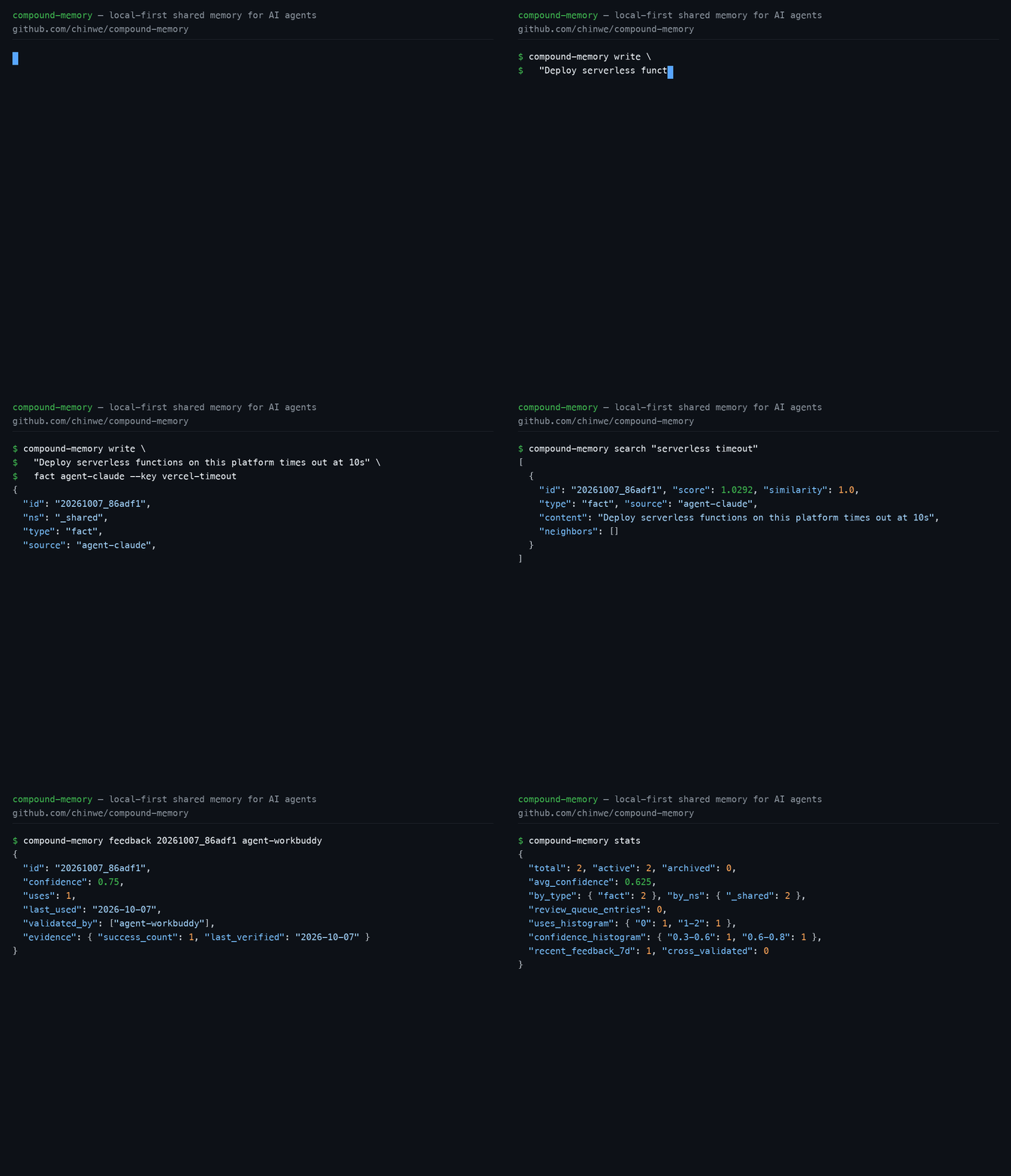
One full loop: write → search → feedback (with cross-host first-validation bonus) → store health. Real output from v0.4.0, long payloads trimmed:
```bash
uv run compound-memory init
```
```json
{ "ok": true, "root": "~/.agents/memory" }
```
Two different hosts each write one stable fact (new memories start at `confidence` 0.5, `uses` 0):
```bash
uv run compound-memory write \
"Deploy serverless functions on this platform times out at 10s — keep handlers under that budget" \
fact agent-claude --key vercel-timeout
```
```json
{
"id": "20261007_86adf1",
"ns": "_shared",
"type": "fact",
"source": "agent-claude",
"content": "Deploy serverless functions on this platform times out at 10s — keep handlers under that budget",
"confidence": 0.5,
"uses": 0,
"key": "vercel-timeout",
"validated_by": []
...
}
```
```bash
uv run compound-memory write \
"User prefers concise replies with tables and code examples" \
fact agent-zcode --key user-style
```
Search ranks by score (`--explain` attaches per-hit ranking components for debugging):
```bash
uv run compound-memory search "serverless timeout"
```
```json
[
{
"id": "20261007_86adf1", "score": 1.0292, "similarity": 1.0,
"type": "fact", "source": "agent-claude",
"content": "Deploy serverless functions on this platform times out at 10s — keep handlers under that budget",
"neighbors": []
},
{
"id": "20261007_6a0c0c", "score": 0.5211, "similarity": 0.4919,
"type": "fact", "source": "agent-zcode",
"content": "User prefers concise replies with tables and code examples",
"neighbors": []
}
]
```
A different host used this memory and reported it back with the default `success` outcome — `uses` +1, `conf` +0.1; and since the reporter `agent-workbuddy` ≠ source `agent-claude`, the first cross-host validation adds another +0.15:
```bash
uv run compound-memory feedback 20261007_86adf1 agent-workbuddy
```
```json
{
"id": "20261007_86adf1",
"confidence": 0.75,
"uses": 1,
"last_used": "2026-10-07",
"validated_by": ["agent-workbuddy"],
"evidence": {
"success_count": 1, "failure_count": 0, "contradiction_count": 0,
"last_verified": "2026-10-07",
"recent": [{ "date": "2026-10-07", "agent": "agent-workbuddy", "outcome": "success" }]
}
...
}
```
Store health at a glance (fixed-bucket histograms, liveness, distillation yield):
```bash
uv run compound-memory stats
```
```json
{
"total": 2, "archived": 0, "active": 2,
"avg_confidence": 0.625,
"by_type": { "fact": 2 },
"by_ns": { "_shared": 2 },
"review_queue_entries": 0,
"uses_histogram": { "0": 1, "1-2": 1, "3-5": 0, "6-9": 0, "10+": 0 },
"confidence_histogram": { "<0.3": 0, "0.3-0.6": 1, "0.6-0.8": 1, "0.8-1.0": 0 },
"recent_feedback_7d": 1, "cross_validated": 0,
"distilled_total": 0, "distilled_recent_7d": 0
}
```
Current `stats` also includes `retrieval` (`mode`: `vector` or `lexical`, plus `reason` when the vector channel is off), `attestation` (`attested`, plus a `warning` when `COMPOUND_MEMORY_AGENT_ID` is unset), and `expired_active` (active-area memories whose `valid_until` has passed; 0 in this snapshot). `cross_validated` counts memories whose `validated_by` lists at least two distinct agents — the single cross-host validation above correctly leaves it at 0. `memory_search` carries the same `retrieval` object. CLI `search` stays a bare array.
Three things to notice:
- New memories start at `confidence` 0.5 and move on **evidence** — feedback carries an outcome: `success` raises it, `failure` lowers it (floor 0.05), `contradiction` freezes it into the review queue, `obsolete` archives immediately.
- First validation from a different host earns an independent bonus (once per host per memory), with `validated_by` / `evidence` trails — confidence is evidence of correctness, not popularity.
- Hits embed one-hop neighbors automatically (empty here — no links yet; `memory_link` creates bidirectional links that get recalled for free).
## How compounding works
| Interest source | Mechanism |
|---|---|
| ① Usage reinforcement | Every `memory_feedback` advances `uses` and `last_used`. Confidence moves by outcome. Default `success`: +0.1. `failure`: −0.2 (floor 0.05, repeaLo que la gente pregunta sobre compound-memory
¿Qué es chinwe/compound-memory?
+
chinwe/compound-memory es mcp servers para el ecosistema de Claude AI. Local multi-agent shared memory with compounding — MCP server + CLI Tiene 1 estrellas en GitHub y su última actualización registrada es del 2026-10-13.
¿Cómo se instala compound-memory?
+
Puedes instalar compound-memory clonando el repositorio (https://github.com/chinwe/compound-memory) o siguiendo las instrucciones del README en GitHub. ClaudeWave también te ofrece bloques de instalación rápida en esta misma página.
¿Es seguro usar chinwe/compound-memory?
+
Nuestro agente de seguridad ha analizado chinwe/compound-memory y le ha asignado un Trust Score de 95/100 (tier: Verified). Revisa el desglose completo de comprobaciones superadas y flags en esta página.
¿Quién mantiene chinwe/compound-memory?
+
chinwe/compound-memory es mantenido por chinwe. La última actividad registrada en GitHub es del 2026-10-13, con 0 issues abiertos.
¿Hay alternativas a compound-memory?
+
Sí. En ClaudeWave puedes explorar mcp servers similares en /categories/mcp, ordenados por popularidad o actividad reciente.
Despliega compound-memory en tu cloud
Lleva este repo a producción en minutos. Cada plataforma genera su propio entorno con variables de entorno editables.
¿Mantienes este repo? Añade un badge a tu README
Pega el badge en tu README de GitHub para mostrar que está auditado por ClaudeWave. Cada badge enlaza de vuelta a esta página y muestra el Trust Score actual.
[](https://claudewave.com/repo/chinwe-compound-memory)<a href="https://claudewave.com/repo/chinwe-compound-memory"><img src="https://claudewave.com/api/badge/chinwe-compound-memory" alt="Featured on ClaudeWave: chinwe/compound-memory" width="320" height="64" /></a>Más MCP Servers

Reverse engineer anything with agents, from app behavior down to native binaries.

Fair-code workflow automation platform with native AI capabilities. Combine visual building with custom code, self-host or cloud, 400+ integrations.

User-friendly AI Interface (Supports Ollama, OpenAI API, ...)

An open-source AI agent that brings the power of Gemini directly into your terminal.

Real-time global intelligence dashboard. AI-powered news aggregation, geopolitical monitoring, and infrastructure tracking in a unified situational awareness interface

🕷️ An adaptive Web Scraping framework that handles everything from a single request to a full-scale crawl! Don't be shy, join here: https://discord.gg/EMgGbDceNQ and follow here for daily tips and tricks: https://x.com/Scrapling_dev