

Per-function CRAP scores from complexity and coverage, churn-ranked worklists, and ratchet gates for code changes. CLI, MCP, and GitHub Action.
- ✓Open-source license (MIT)
- ✓Actively maintained (<30d)
- ✓Clear description
- ✓Topics declared
- ✓Documented (README)
claude mcp add crapkit -- python -m crapkit{
"mcpServers": {
"crapkit": {
"command": "python",
"args": ["-m", "pytest"]
}
}
}Resumen de MCP Servers
# crapkit <!-- mcp-name: io.github.JeanFrancoisGagne/crapkit --> [](https://github.com/JeanFrancoisGagne/crapkit/actions/workflows/ci.yml) [](https://pypi.org/project/crapkit/) [](https://pypi.org/project/crapkit/) [](https://github.com/JeanFrancoisGagne/crapkit/blob/main/LICENSE) [](https://glama.ai/mcp/servers/JeanFrancoisGagne/crapkit) 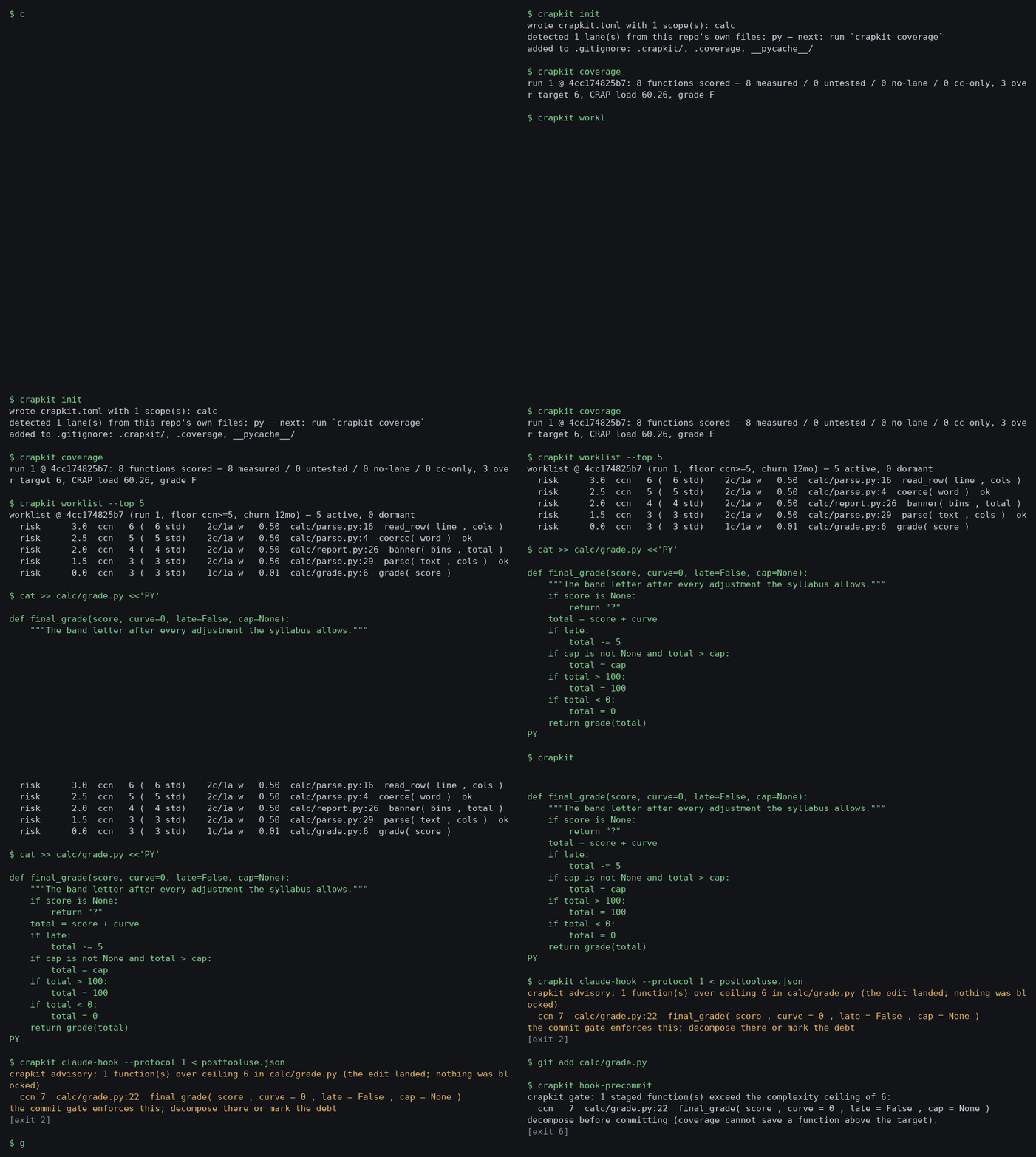 crapkit scores every function in your repo on complexity times uncovered risk, ranks the worst ones by how often the file changes, and blocks commits that add more. It reads Python, TypeScript, TSX, JavaScript, Swift, Go, Rust, shell, PowerShell, C and C++, Objective-C, Vue, Java and Zig through [lizard](https://github.com/terryyin/lizard), and joins per-function branch coverage from the istanbul or coverage.py artifact your own test command already writes. JSON commands use sorted keys and a versioned schema for scripts, coding agents and the optional MCP server. ``` CRAP = ccn^2 * (1 - cov)^3 + ccn ``` The name is not ours: C.R.A.P. (Change Risk Anti-Patterns) was coined for crap4j by Alberto Savoia and Bob Evans in 2007. `ccn` is the smaller of standard and modified cyclomatic complexity, both read off one lizard pass. `cov` is branch coverage inside the function's span; with no branches it falls back to statement coverage, and with no statements to invoked-or-not, so a half-executed straight-line function never reads as fully covered. **Above the ceiling, coverage cannot save you. Decompose.** At the default target of 6, a function at ccn 7 with 100% coverage still scores 7 and still fails the gate. The only move that clears it is splitting the function. **Why 6 and not 30.** crap4j's conventional threshold of 30 is a CRAP score: it lets an untested `ccn 5` through (25 + 5 = 30) and a fully covered `ccn 30` too. crapkit's default is a complexity ceiling, because coverage can at best collapse CRAP to `ccn`, and a function you cannot cover past `ccn 6` is one you decompose. Set `target = 30` in `crapkit.toml` if you want the crap4j number. A repo with existing debt does not need to: `ratchet seed` marks today's over-ceiling functions at today's score, the gate then judges only the functions a change touches, and marks may only fall, so adoption never starts with a wall of red. Next to crap4py, radon, xenon, wily and SonarQube: [docs/comparison.md](https://github.com/JeanFrancoisGagne/crapkit/blob/main/docs/comparison.md). crapkit scores **git-tracked files only**. Source you have not `git add`ed is invisible to it. | Start with | When | |---|---| | [Install](#install) and [the 60-second start](#the-60-second-start) | You want the first score in an existing Git repository. | | [Python](#quickstart-python) or [TypeScript](#quickstart-typescript) quickstart | You want a worked example from setup through a passing verify. | | [Adoption](https://github.com/JeanFrancoisGagne/crapkit/blob/main/docs/adoption.md) | You need to choose scopes, wire tests or introduce a ratchet to existing debt. | | [Upgrading](https://github.com/JeanFrancoisGagne/crapkit/blob/main/docs/upgrading.md) | You already have saved runs, ratchet marks or an installed plugin. | | [Subcommands](#subcommands) and [JSON/MCP reference](https://github.com/JeanFrancoisGagne/crapkit/blob/main/docs/agent-json.md) | You are scripting commands or connecting a coding agent. | --- ## The 60-second start ``` pip install crapkit cd your-repo crapkit init # write crapkit.toml and ignore measurement output crapkit doctor # check scopes, test commands and coverage dependencies crapkit coverage # runs the lane, joins coverage, stores a scored run crapkit worklist # the ranked risk map crapkit ratchet seed git add crapkit.toml crapkit-ratchet.tsv .gitignore ``` `init` detects pytest, Vitest and Jest from the repository's own files. Review the generated config before running its commands. When detection leaves a commented lane, fill it in using the [lane recipes](https://github.com/JeanFrancoisGagne/crapkit/blob/main/docs/lanes.md). Commit the adoption files, then run `crapkit verify` to establish a passing verdict. Install the [commit gate](#the-gate) when the config and ratchet are ready. `coverage` scores, `worklist` ranks: ``` $ crapkit coverage run 1 @ fae4db93108: 2 functions scored: 2 measured, 1 over ceiling 6, CRAP load 41.0, grade F -> next: crapkit worklist $ crapkit worklist worklist @ fae4db93108 (run 1, floor ccn>=5, churn 12mo) - 1 of 1 active (worklist_top 50), 0 dormant risk 14.0 ccn 14 crap 38.5 cov 50% 1c/1a calc/grade.py:7 classify( score , attempts , late , bonus ) ``` `risk 14.0` is ccn times a churn weight of one: a one-commit repo has no spread of commits to weight, so each commit counts once and the ranking is complexity order until the history grows ([Risk](#risk-what-ranks-the-worklist)). `crap 38.5` and `cov 50%` are the score and the coverage behind it. `ratchet seed` signs today's debt at today's score. From then on marks only ever fall, so the repo can get better and never worse while you burn it down. **One thing stops most first runs: the coverage plugin.** `init` writes a lane that shells out to your own test runner, and the runner needs its coverage package installed: `pytest-cov` for pytest, `@vitest/coverage-v8` (pinned to your vitest major) for vitest. Without it the lane produces no artifact and `coverage` exits 5 quoting the runner's own error. For pytest, `init` probes the python its lane will run and prints the install command when `pytest_cov` is missing; `pip install "crapkit[py]"` pulls the plugin alongside crapkit when the two share a venv. On a Windows PATH holding only the `py` launcher it writes `py`, not a `python3` the lane could never run, and when cmd.exe cannot start the interpreter at all (exit 9009, the Store alias) it names that instead of guessing at pytest-cov. A repo that pins no lockfile and carries its own `.venv` gets that venv's interpreter in the lane, when that interpreter can import pytest, rather than whichever python the shell answers with. The two quickstarts below walk a real repo end to end. **On Windows a lane command is read by cmd.exe**, the shell that will run it, not by sh. Double quotes are the portable quoting. A single-quoted value is refused at config load with exit 3, because cmd.exe would hand pytest five words and the lane would write no artifact: ``` # the lane in crapkit.toml command = "python -m pytest -m 'not live and not perf' --cov=calc --cov-branch --cov-report=json:.crapkit/cov/py.json" $ crapkit doctor crapkit: lane 'py': positional argument 'live' narrows a full-suite coverage run; drop it, attach it to the flag it belongs to (-n8, --numprocesses=8), or set full_suite = false deliberately (cmd.exe does not treat ' as a quote: write the value in double quotes); a suite whose testpaths cannot be collected in one process needs one lane per testpath, each with full_suite = false and its own artifact ``` Write it `-m "not live and not perf"`. Carets, `&&` and `|` segments, redirections and empty quoted arguments all read the way the shell reads them, so a chained lane (`cd tests && python -m pytest --cov ...`) is checked one segment at a time. `doctor` reads a lane the same way, and FAILs one whose runner will not start. ## Install ``` pip install crapkit ``` That is the release on [PyPI](https://pypi.org/project/crapkit/). For the unreleased tip of `main`, or from a local clone (run at the clone root): ``` pip install git+https://github.com/JeanFrancoisGagne/crapkit.git pip install . ``` Requires Python 3.11 or newer and Git on PATH. The CLI has one runtime dependency, `lizard>=1.24.0`; a package mirror needs both distributions. Install into the environment you intend to use, then check `crapkit --version`. The `pip install -e ".[dev]"` under [Development](#development) is a different thing: it adds the test extra, for people changing crapkit. Python projects can install `pip install "crapkit[py]"` in their test environment to include pytest-cov and subprocess-capable coverage.py. A separate tool installation still needs the coverage plugin in the environment that runs the suite. Analysis and scoring run locally and send no telemetry. Configured lane, mutation and alert commands run with your permissions and can contact services or change files. Review those commands before running Crapkit in a repository you do not trust ([SECURITY.md](https://github.com/JeanFrancoisGagne/crapkit/blob/main/SECURITY.md)). ``` $ crapkit --version crapkit 0.7.0 ``` `python -m crapkit` works identically to the console script and is what to use from a source checkout. Every subcommand accepts `--repo PATH` (default: the nearest `crapkit.toml` at or above the current directory, so a monorepo workspace finds the root's), and with it you never have to `cd` into the repo you are scoring; [Subcommands](#subcommands) shows where the flag goes. ## Upgrading Keep the CLI and plugin versions aligned, measure fresh coverage after upgrading, and review any ratchet identity refusal before reseeding. The current reader is analysis version 10; older JavaScript and TypeScript callback marks can require a reviewed mapping. Follow the [upgrade guide](https://github.com/JeanFrancoisGagne/crapkit/blob/main/docs/upgrading.md) for saved state, portable records and Windows lau
Lo que la gente pregunta sobre crapkit
¿Qué es JeanFrancoisGagne/crapkit?
+
JeanFrancoisGagne/crapkit es mcp servers para el ecosistema de Claude AI. Per-function CRAP scores from complexity and coverage, churn-ranked worklists, and ratchet gates for code changes. CLI, MCP, and GitHub Action. Tiene 1 estrellas en GitHub y su última actualización registrada es del 2026-09-08.
¿Cómo se instala crapkit?
+
Puedes instalar crapkit clonando el repositorio (https://github.com/JeanFrancoisGagne/crapkit) o siguiendo las instrucciones del README en GitHub. ClaudeWave también te ofrece bloques de instalación rápida en esta misma página.
¿Es seguro usar JeanFrancoisGagne/crapkit?
+
Nuestro agente de seguridad ha analizado JeanFrancoisGagne/crapkit y le ha asignado un Trust Score de 95/100 (tier: Verified). Revisa el desglose completo de comprobaciones superadas y flags en esta página.
¿Quién mantiene JeanFrancoisGagne/crapkit?
+
JeanFrancoisGagne/crapkit es mantenido por JeanFrancoisGagne. La última actividad registrada en GitHub es del 2026-09-08, con 6 issues abiertos.
¿Hay alternativas a crapkit?
+
Sí. En ClaudeWave puedes explorar mcp servers similares en /categories/mcp, ordenados por popularidad o actividad reciente.
Despliega crapkit en tu cloud
Lleva este repo a producción en minutos. Cada plataforma genera su propio entorno con variables de entorno editables.
¿Mantienes este repo? Añade un badge a tu README
Pega el badge en tu README de GitHub para mostrar que está auditado por ClaudeWave. Cada badge enlaza de vuelta a esta página y muestra el Trust Score actual.
[](https://claudewave.com/repo/jeanfrancoisgagne-crapkit)<a href="https://claudewave.com/repo/jeanfrancoisgagne-crapkit"><img src="https://claudewave.com/api/badge/jeanfrancoisgagne-crapkit" alt="Featured on ClaudeWave: JeanFrancoisGagne/crapkit" width="320" height="64" /></a>Más MCP Servers

Fair-code workflow automation platform with native AI capabilities. Combine visual building with custom code, self-host or cloud, 400+ integrations.

User-friendly AI Interface (Supports Ollama, OpenAI API, ...)

An open-source AI agent that brings the power of Gemini directly into your terminal.

Real-time global intelligence dashboard. AI-powered news aggregation, geopolitical monitoring, and infrastructure tracking in a unified situational awareness interface

The fastest path to AI-powered full stack observability, even for lean teams.

🕷️ An adaptive Web Scraping framework that handles everything from a single request to a full-scale crawl!