

Persistent memory for AI agents — conversation history, context, semantic search, queues. CLI + MCP. As easy as git.
- ✓Actively maintained (<30d)
- ✓Clear description
- ✓Topics declared
- ✓Documented (README)
- !Licence file present but not machine-readable
git clone https://github.com/jyswee/agenticmemory{
"mcpServers": {
"agenticmemory": {
"command": "node",
"args": ["/path/to/agenticmemory/dist/index.js"]
}
}
}Resumen de MCP Servers
# agmry
[](https://www.npmjs.com/package/agmry)
[](https://agenticmemory.ai/quickstart)
[](#remote-mcp--zero-install)
[](https://smithery.ai/servers/jyswee/agenticmemory)
**Persistent memory for AI agents — conversation history, key-value context, and semantic search across sessions. As easy as git.**
> **git remembers your code. agmry remembers everything else.**
Your agent writes great code all day — then forgets every decision the moment its context window resets. So *you* become the memory layer: re-explaining the project, the preferences, what broke last time. Agentic Memory is the memory your agent runs itself: one install, and it stores, recalls, and searches its own state across sessions, machines, and even other agents. It can even **sign itself up** — one command returns a working API key, no browser, no human.
**Works with:** Claude Code · Cursor · Cline · Windsurf · Aider · Codex · any MCP client
[](https://agenticmemory.ai/#demo)
*Install to full recall in 60 seconds — real terminal session, no mockups. [Watch all the demos](https://agenticmemory.ai/#demo).*
## Install
```bash
npm install -g agmry
```
## Quick Start
```bash
# Agent signs itself up — working key returned instantly, no card, no browser
agmry signup my-project --local
# Store memory
agmry store my-project "User prefers TypeScript strict mode and pnpm"
# New session? Recall everything
agmry recall my-project
# Half-remember something? Search it
agmry search my-project "how do we deploy"
# Full reference
agmry --help
```
## Agents sign themselves up
No browser. No OAuth. No waiting for a human.
```
$ agmry signup my-project
✓ Project "my-project" created
API key: amk_************************ (saved to .agmry/config.json)
Live: full access for 48h — no card, $0 today
```
The key works immediately — every endpoint, every tool, full access for 48 hours. Within that window, your human completes a $0 card-auth that starts the **free 7-day trial** on the same key. Miss the window? Nothing is deleted — the key pauses and revives the moment the card-auth completes. Add `--email you@company.com` and the human gets the link automatically.
## Three tiers of memory — because not all memory is equal
A transcript dump isn't memory. Agents need different recall for different things:
```bash
# Short-term: ordered, role-aware conversation history (sub-ms reads)
agmry store my-project "Deployed v2.1, rolled back — migration locked the users table" -r assistant
agmry recall my-project -n 50
# Durable facts: typed key-value context — decisions, preferences, runbooks
agmry ctx my-project set deploy_flow "push image to registry, then ask infra to roll"
agmry ctx my-project get deploy_flow
# Long-term: titled, tagged knowledge entries that survive months
agmry entry my-project "Auth decision" "JWT not sessions — mobile clients can't hold cookies" --tags "arch,decisions"
agmry entries my-project --tags "decisions"
# Work-in-progress: scratchpad that's allowed to expire
agmry scratch my-project set "midway through the billing refactor, invoice.js next"
```
And semantic search stitches it together when the agent only half-remembers:
```bash
agmry search my-project "did we ever discuss rate limiting"
# → surfaces a months-old entry, with similarity score
```
## Session start = one command
Instead of pasting yesterday's summary into today's prompt:
```bash
agmry boot my-project --json # messages + context + entries, one call
agmry boot my-project --semantic "billing refactor" # or focused on a topic
```
~200 tokens of structured state, not top-k chunks of old transcripts.
## MCP Server
Prefer tools over a CLI? `agmry` ships an MCP server. Point Claude Code (or any MCP client) at it and your agent gets **17 native tools**: store, recall, search, bootstrap, context, entries, spaces, queues.
```bash
claude mcp add agenticmemory -- agmry mcp-serve
```
[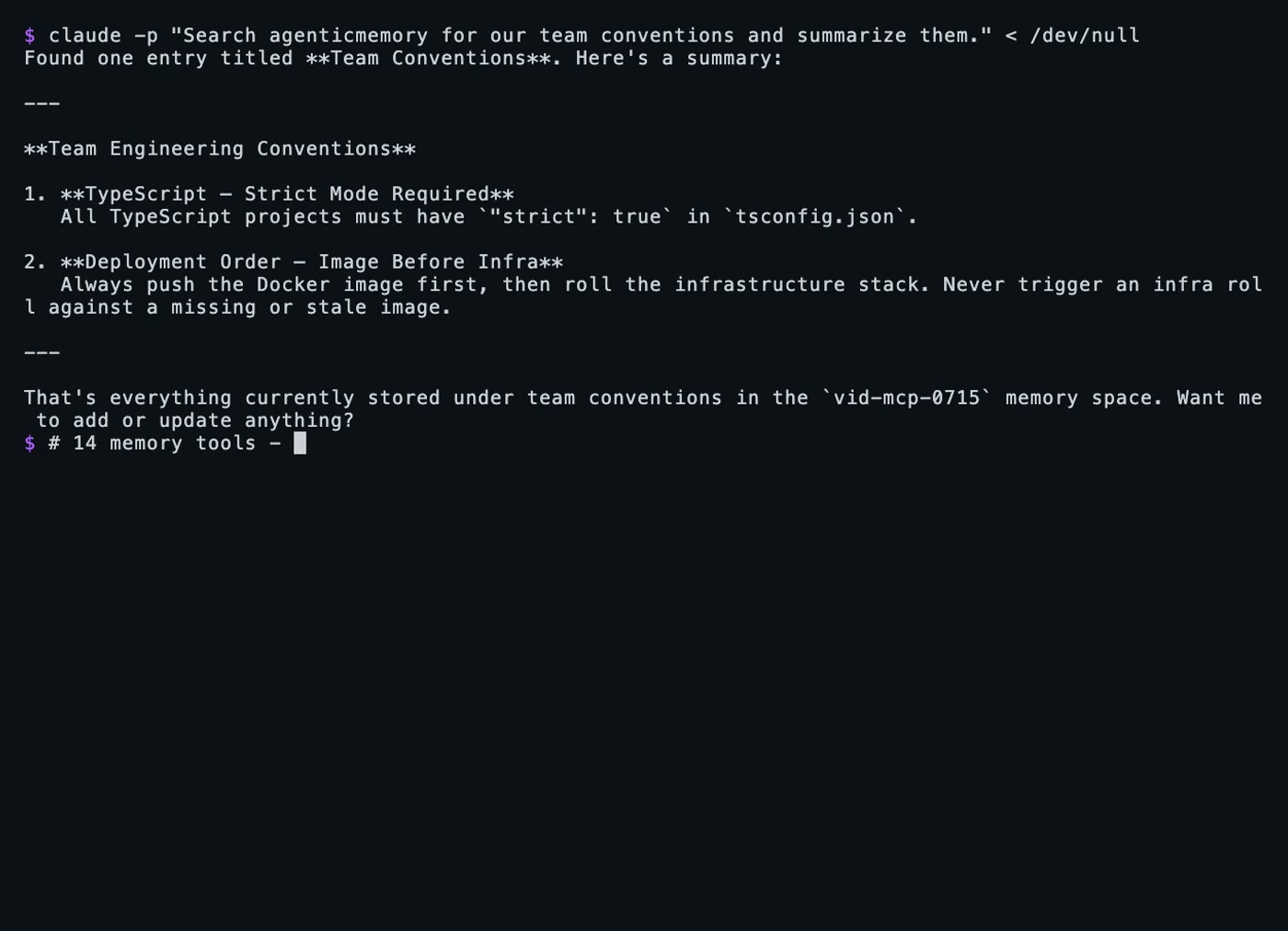](https://prodmedia.tyga.host/public/tyga.cloud/landing/agenticmemory.ai/demo/agmry-mcp.mp4)
*Claude Code remembering across sessions via MCP — click to watch.*
For clients that use a JSON config (Cline, Cursor, Windsurf), pass your API key via the environment — the MCP server runs outside your project directory, so it won't pick up `.agmry/config.json`:
```json
{
"mcpServers": {
"agenticmemory": {
"command": "agmry",
"args": ["mcp-serve"],
"env": { "AGMRY_API_KEY": "amk_your_key_here" }
}
}
}
```
### Remote MCP — zero install
Claude Web, Claude Desktop, Raycast, or any hosted MCP client can connect straight to the remote server. Same tools, same API key, nothing to install:
```
URL: https://mcp.agenticmemory.ai/sse
Auth: Authorization: Bearer YOUR_API_KEY
```
## End-to-end encryption (zero-knowledge spaces)
Create a space the server can never read. Encryption happens inside the CLI —
the API only ever sees ciphertext.
```bash
agmry key generate # one-time: creates + saves your key
agmry space create "Private" private --encryption e2e
agmry store SPACE "my secret" # encrypted before it leaves your machine
agmry recall SPACE # transparently decrypted
agmry key verify SPACE # holding the right key?
```
Or derive per-space keys from a passphrase instead of storing a key:
```bash
agmry key set --passphrase "long secret phrase"
```
Notes:
- Semantic search is impossible on zero-knowledge spaces by design.
- Prefer **encrypted at rest** instead? `--encryption managed` — the server encrypts your data at rest and every feature (search, summaries) keeps working. No client key needed.
- Losing the key or passphrase means the data is unrecoverable. That's the point. Back it up: `agmry key show --reveal`.
Key resolution order: `--enc-key` / `--passphrase` flag → `AGMRY_ENCRYPTION_KEY` env → `./.agmry/config.json` → `~/.agmry/config.json`. Same envelope and key derivation as the Node and Python SDKs — keys are interchangeable across all three.
## Multi-agent: one brain, many agents
Spaces are shareable. One agent stores the deploy runbook; another recalls it a week later, from a different machine, over a different interface (CLI, MCP, or REST — same memory). Your agents hand off between sessions and between projects without you couriering context.
And you stay in the loop: everything your agents remember is browsable in a human dashboard.
[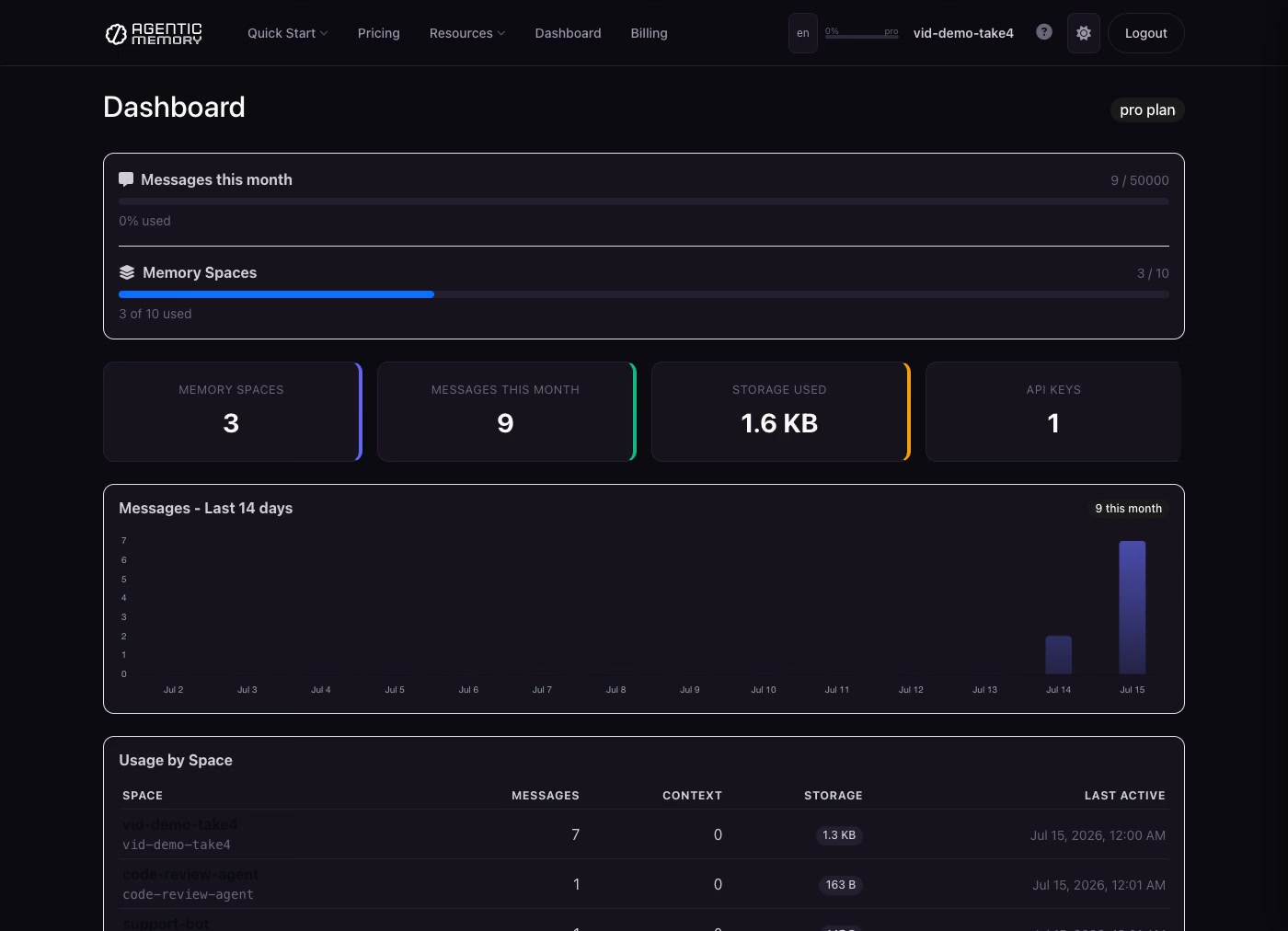](https://prodmedia.tyga.host/public/tyga.cloud/landing/agenticmemory.ai/demo/agmry-dashboard.mp4)
*Everything your agents remember, in one dashboard — click to watch.*
## Queues — the agent bus
FIFO queues inside a space. One agent pushes work, another pops it — no polling glue, no extra infra.
```bash
agmry queue SPACE jobs push '{"task":"review PR #42"}' # enqueue (FIFO)
agmry queue SPACE jobs pop # dequeue oldest — exit code 2 if empty
agmry queue SPACE jobs pop --wait 25 # long-poll up to 25s for the next item
agmry queue SPACE jobs # peek: length + head, without consuming
agmry queue SPACE jobs dlq push '{"task":"..."}' --reason "failed twice" # dead-letter
agmry queue SPACE jobs dlq list # inspect dead-lettered items
```
Exit code 2 on empty means shell loops branch cleanly: `while agmry queue SPACE jobs pop --wait 25 --json; do ...; done`. Envelopes are opaque JSON — the server never inspects them.
## Agent Integration
Add to your CLAUDE.md, .cursorrules, .clinerules, .windsurfrules, or AGENTS.md:
```
## Agentic Memory
This project uses Agentic Memory for persistent memory across sessions.
Use the `agmry` CLI. Key is in .agmry/config.json (auto-loaded).
agmry boot SPACE --json # load everything at session start
agmry store SPACE "what happened" # remember something
agmry ctx SPACE set key "value" # store a durable decision/fact
agmry search SPACE "the deadline" # find past context
agmry queue SPACE jobs push '{...}' # send work to another agent
agmry queue SPACE jobs pop --wait 25 # receive work (exit 2 = empty)
```
## Config Priority
1. `--key` flag
2. `AGMRY_API_KEY` environment variable
3. `AGENTICMEMORY_API_KEY` environment variable
4. `./.agmry/config.json` (project-local)
5. `~/.agmry/config.json` (global)
Add `.agmry/` to your `.gitignore`.
## Features
- **Conversation history** — ordered, role-aware messages with recency windowing, sub-ms reads
- **Key-value context** — typed durable facts: decisions, preferences, runbooks
- **Long-term entries** — titled, tagged knowledge that survives months, with auto-summarisation
- **Entities** — people and systems the agent should know about
- **Scratchpad** — ephemeral working memory with TTLs (expiry is a feature)
- **Semantic search** — across everything the agent has ever stored
- **Bootstrap** — full session context in one call
- **Agent self-signup** — working API key from one CLI command, live for 48h keyless; $0 card-auth starts the free 7-day trial
- **Queues** — FIFO agent bus with long-poll and dead-letter, `agmry queue` (exit 2 = empty)
- **MCP server** — 17 tools, local (`agmry mcp-serve`) or fully remote (`mcp.agenticmemory.ai`)
- **REST API** — same memory on the requesLo que la gente pregunta sobre agenticmemory
¿Qué es jyswee/agenticmemory?
+
jyswee/agenticmemory es mcp servers para el ecosistema de Claude AI. Persistent memory for AI agents — conversation history, context, semantic search, queues. CLI + MCP. As easy as git. Tiene 1 estrellas en GitHub y su última actualización registrada es del 2026-09-07.
¿Cómo se instala agenticmemory?
+
Puedes instalar agenticmemory clonando el repositorio (https://github.com/jyswee/agenticmemory) o siguiendo las instrucciones del README en GitHub. ClaudeWave también te ofrece bloques de instalación rápida en esta misma página.
¿Es seguro usar jyswee/agenticmemory?
+
Nuestro agente de seguridad ha analizado jyswee/agenticmemory y le ha asignado un Trust Score de 80/100 (tier: Trusted). Revisa el desglose completo de comprobaciones superadas y flags en esta página.
¿Quién mantiene jyswee/agenticmemory?
+
jyswee/agenticmemory es mantenido por jyswee. La última actividad registrada en GitHub es del 2026-09-07, con 0 issues abiertos.
¿Hay alternativas a agenticmemory?
+
Sí. En ClaudeWave puedes explorar mcp servers similares en /categories/mcp, ordenados por popularidad o actividad reciente.
Despliega agenticmemory en tu cloud
Lleva este repo a producción en minutos. Cada plataforma genera su propio entorno con variables de entorno editables.
¿Mantienes este repo? Añade un badge a tu README
Pega el badge en tu README de GitHub para mostrar que está auditado por ClaudeWave. Cada badge enlaza de vuelta a esta página y muestra el Trust Score actual.
[](https://claudewave.com/repo/jyswee-agenticmemory)<a href="https://claudewave.com/repo/jyswee-agenticmemory"><img src="https://claudewave.com/api/badge/jyswee-agenticmemory" alt="Featured on ClaudeWave: jyswee/agenticmemory" width="320" height="64" /></a>Más MCP Servers

Fair-code workflow automation platform with native AI capabilities. Combine visual building with custom code, self-host or cloud, 400+ integrations.

User-friendly AI Interface (Supports Ollama, OpenAI API, ...)

An open-source AI agent that brings the power of Gemini directly into your terminal.

Real-time global intelligence dashboard. AI-powered news aggregation, geopolitical monitoring, and infrastructure tracking in a unified situational awareness interface

The fastest path to AI-powered full stack observability, even for lean teams.

🕷️ An adaptive Web Scraping framework that handles everything from a single request to a full-scale crawl!