

Audit trail and traceability for AI agents. See what every coding agent did, with opt-in human approval and signed certify.
- ✓Open-source license (MIT)
- ✓Actively maintained (<30d)
- ✓Clear description
- ✓Topics declared
- ✓Documented (README)
git clone https://github.com/The-Pixel-Boys/shield-kya && cp shield-kya/*.md ~/.claude/agents/Resumen de Subagents
# `@shield-agent/kya` [](https://www.npmjs.com/package/@shield-agent/kya) [](https://www.npmjs.com/package/@shield-agent/kya) [](https://www.npmjs.com/package/@shield-agent/kya) [](./LICENSE) [](https://shield-agent.com/install) [](https://x.com/coscosmico) **Audit trail and traceability for AI agents.** See what every coding agent did, with opt-in human approval and signed certify. Every tool call is recorded on a live local dashboard and certifiable against the Agent Trust Baseline. Locally KYA is advisory and fails open, except for a small never-list that is denied; enforcement lives on the MCP gate path and the hosted plane. One command. Free forever under MIT. ```bash npm i -g @shield-agent/kya@latest && kya start ``` Requires **Node.js 24+**. Restart Cursor / Claude Code / Codex once so MCP loads. Hosted desk: [shield-agent.com](https://shield-agent.com/install). CLI and local MCP gate for Shield’s Know Your Agent path. An agent that asks Shield first gets Allow, Review, or Deny: you register the agent, wrap the tool (or route it through the MCP gate or the hosted plane), and Review waits for a person. Local hooks only record and block the never-list (see [Hook interception](#hook-interception)); hosted is where enforcement lives. This package does not scan your network. Agents that never call evaluate stay invisible on purpose. Walkthrough: [how you use it](https://shield-agent.com/how-kya-works#using). ```bash npx @shield-agent/kya@latest --help ``` Requires **Node.js 24+** (`engines.node: >=24`). On an older Node the CLI offers to install 24 for you (via volta / fnm / nvm / brew), reinstall itself, and finish the command - declining just prints a warning and continues. It works with any host that speaks MCP or OpenAPI. Vertical packs are optional. Shield is the only policy decision point: this gate never auto-approves an irreversible side effect. If `KYA_API_KEY` is empty against an authenticated plane, network commands exit non-zero. `eval-tool`, `wrap`, and `invoke` exit `0` on ALLOW, `4` on REQUIRE_APPROVE, and `1` on DENY or unknown, so a line like `eval-tool && write` cannot skip the gate. `--offline` runs sample evaluate without a paid cloud (useful for DENY and REQUIRE_APPROVE demos). Creating an agent is itself a tool: offline, `kya.agent.register` comes back REQUIRE_APPROVE. Allow, break-glass, and approve mint modes live on the control plane. ## One liner ```bash npm i -g @shield-agent/kya@latest && kya start ``` Run it in your project directory. (From a clone of this repo, `./scripts/install-local.sh` replaces the npm install.) More ways to install (same package; npm stays the reference path): ```bash # Homebrew. Homebrew 7 may ask you to trust a third-party tap: run `brew tap The-Pixel-Boys/tap` first. # The formula installs about 270MB because of the optional semantic-search runtime. brew install The-Pixel-Boys/tap/shield-kya # Scoop (not yet verified on Windows) scoop bucket add The-Pixel-Boys https://github.com/The-Pixel-Boys/scoop-bucket.git scoop install shield-kya ``` Claude Code and GitHub Copilot CLI users can also install the [plugin](#claude-code--github-copilot-cli-plugin). That **inits** `.kya/`, **wires** local MCP (`.mcp.json`, `mcp.json`, `.cursor/mcp.json` → `kya serve-mcp --stdio`), also **wires user-level configs for every installed host it detects** (`~/.claude.json`, `~/.kimi-code/`, `~/.grok/`, `~/.cursor/`, …), and **opens** the live activity report. The report runs in the background - you get your terminal back; `kya stop` stops it, `kya receipt --open` reopens it. Cursor, Kiro, Qwen, Amp, Droid, Cline, and Grok pick the server up live with no restart (Kimi: just a new session); Claude Code, Codex, OpenCode, Gemini, Copilot CLI, and Kilo CLI load it on next launch - `claude --resume` keeps your conversation. 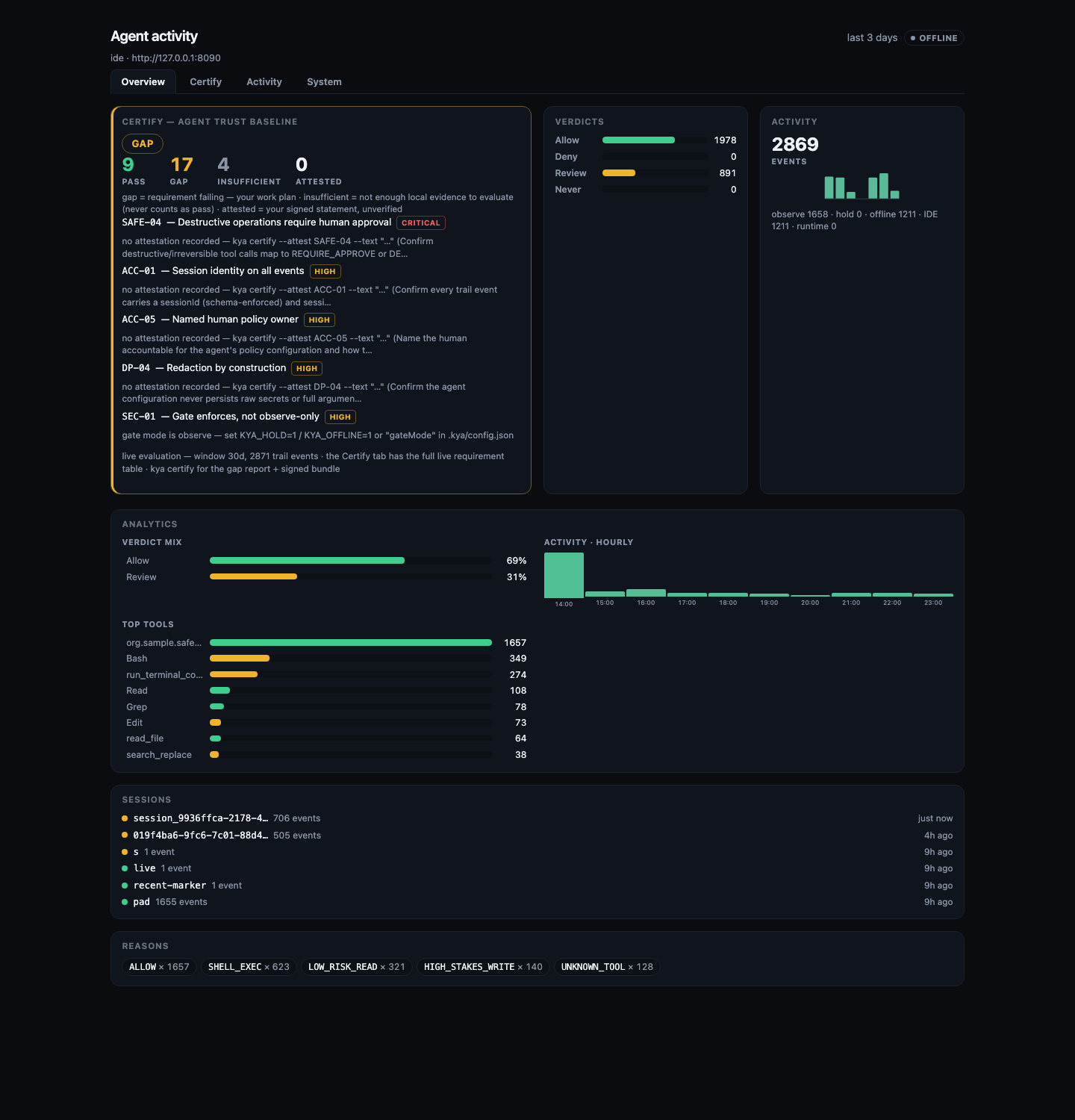 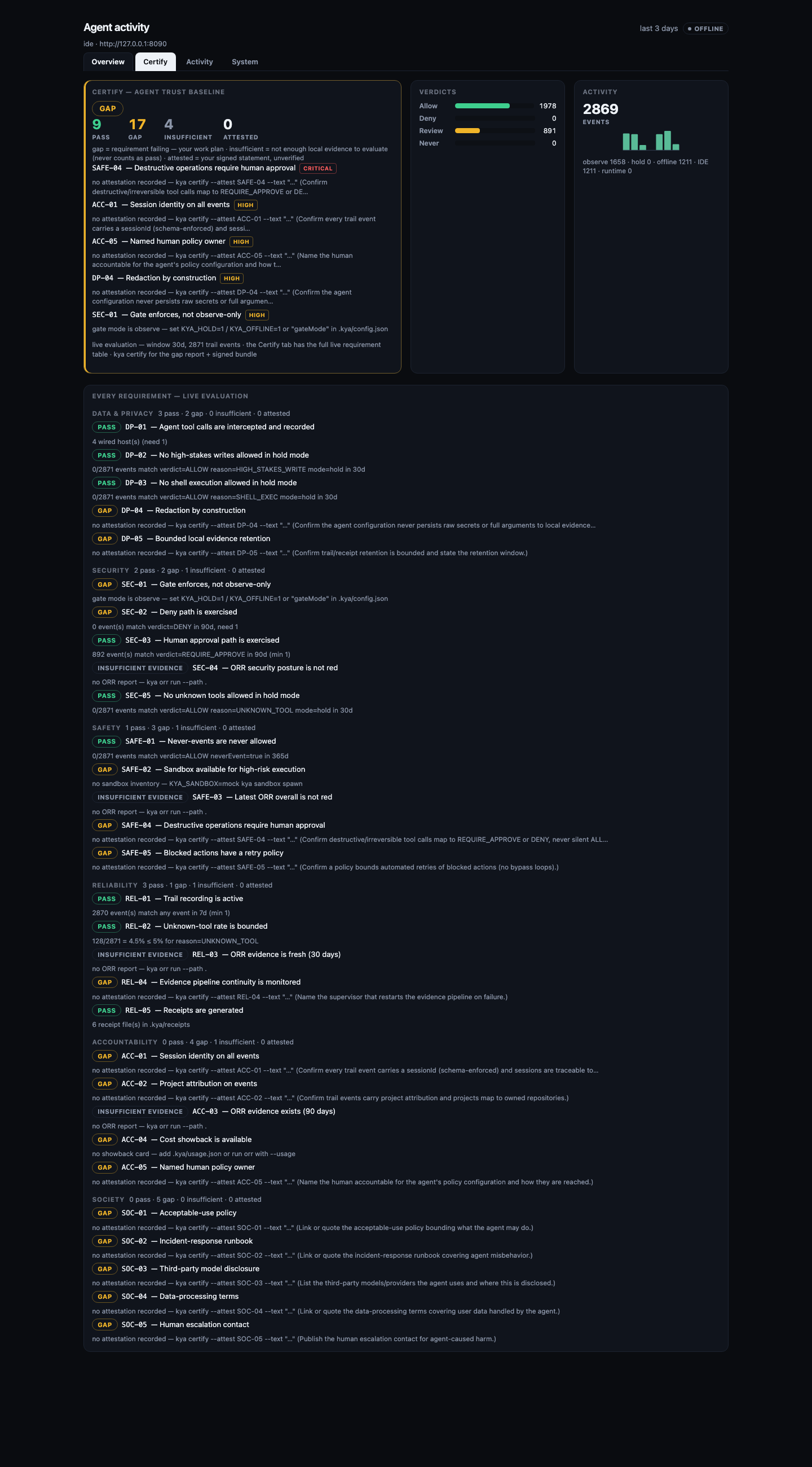 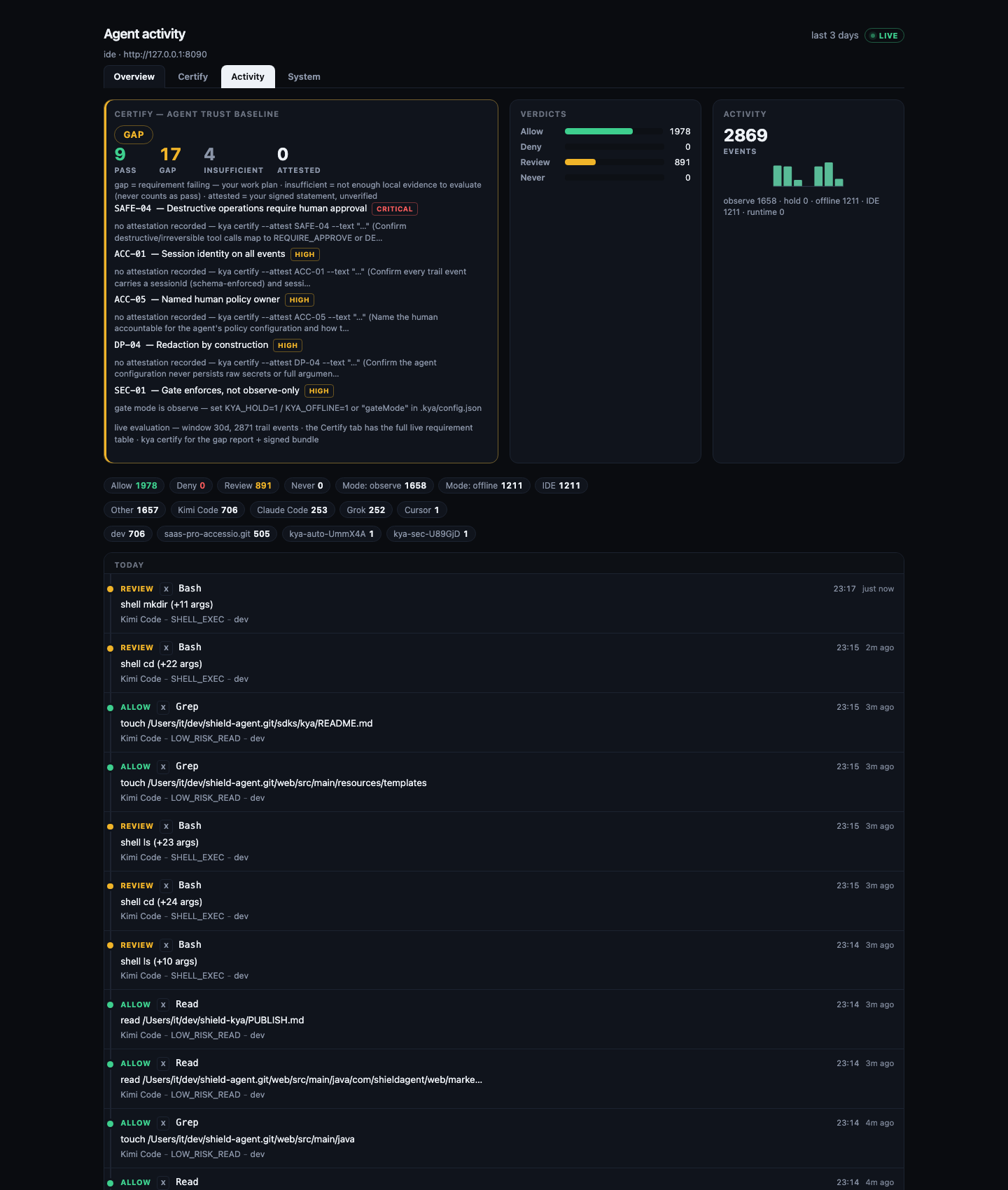 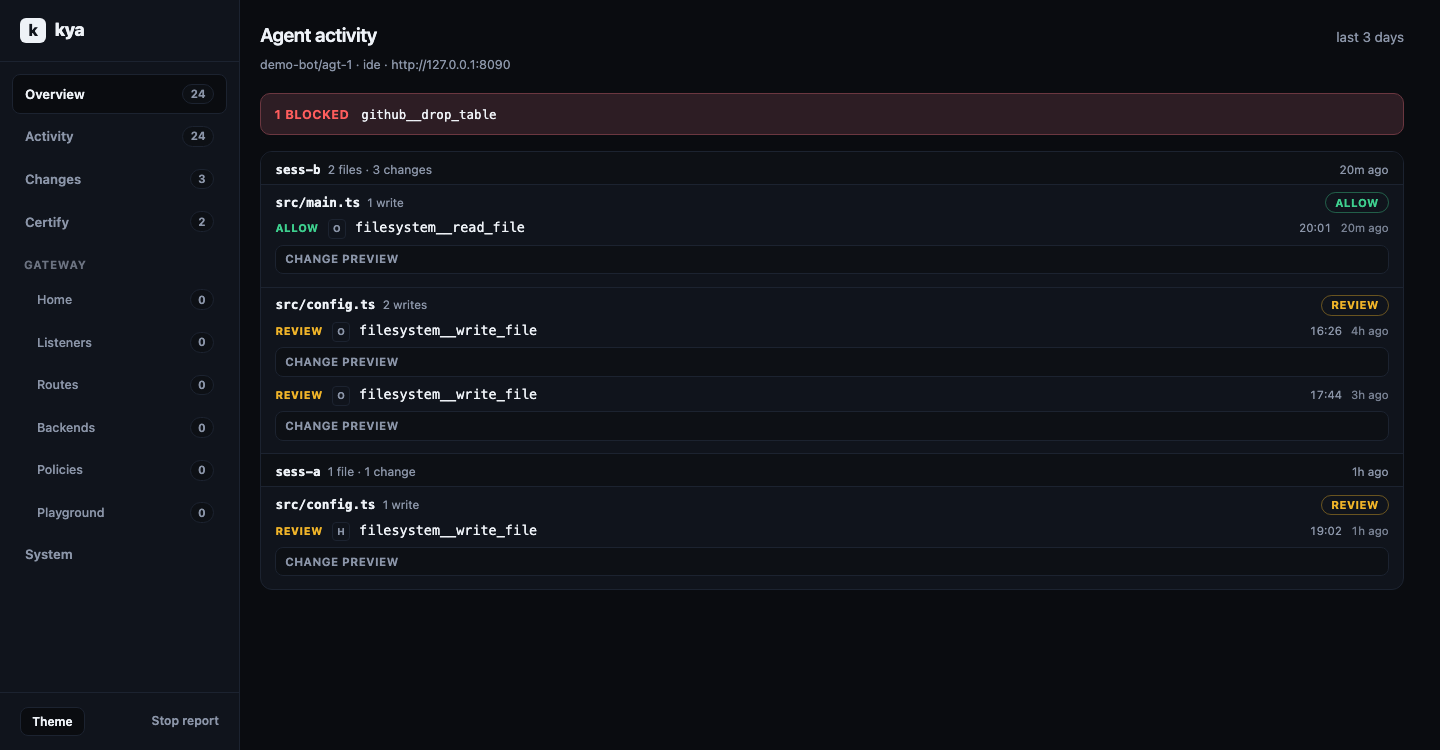 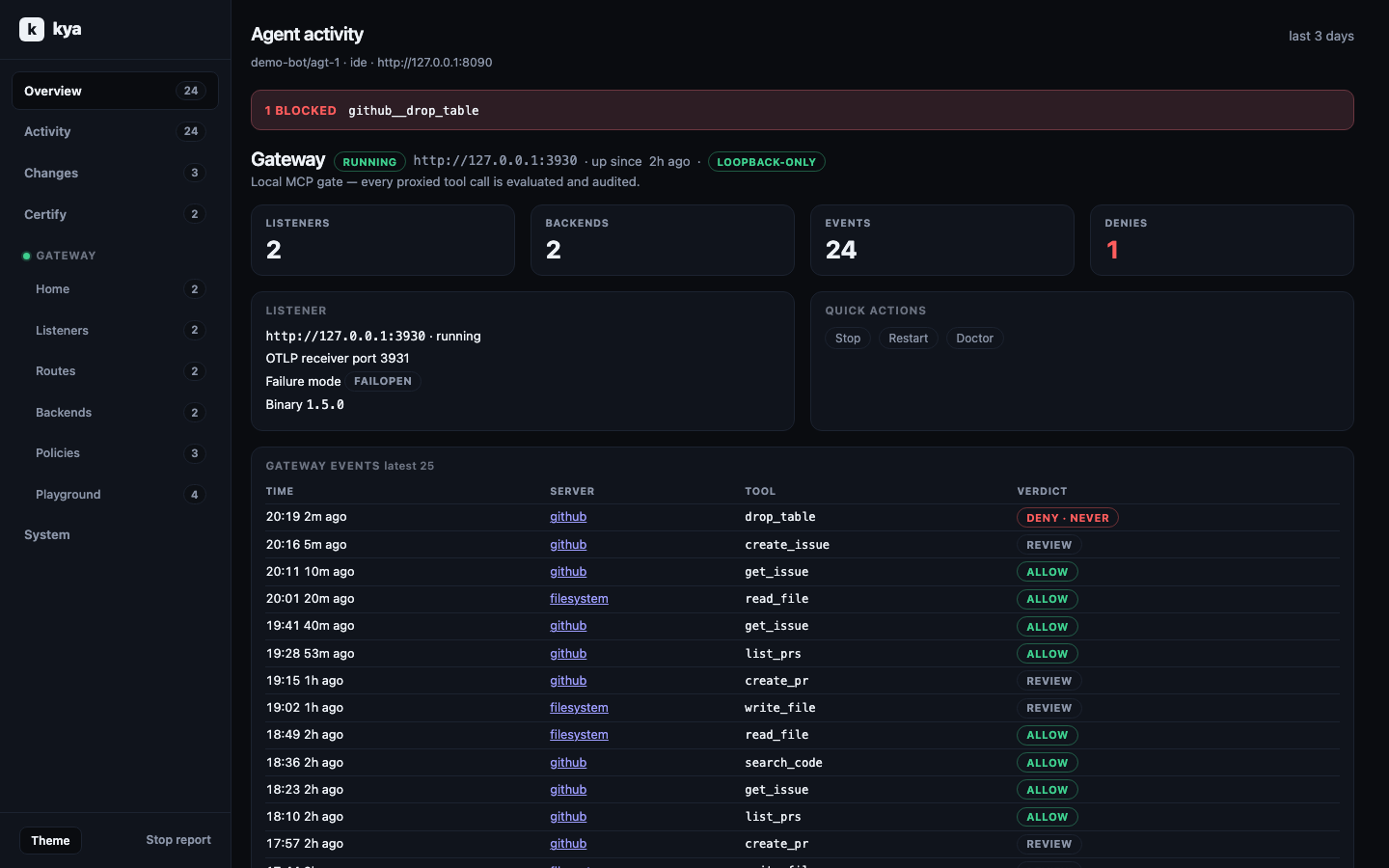 <!-- Local paths kept in package for offline viewers: assets/report-overview.png, assets/report-certify.png, assets/report-activity.png, assets/report-changes.png, assets/report-gateway.png (legacy: assets/activity-receipt.png) --> ```bash kya start --no-open # wire only kya start --force # rewrite MCP blocks # Receipt change previews (clipped + redacted): on by default for writes # KYA_DIFF_PREVIEW=0 to disable ``` ## One command per host `kya start` covers Claude Code, Cursor, and any host that reads `.mcp.json` - and auto-wires the user-level config of every installed host it detects. For the rest, `kya connect` writes the host's own config dialect directly: ```bash kya connect claude # ~/.claude.json (merges mcpServers only) kya connect grok # ~/.grok/config.toml (appends [mcp_servers.shield-kya]) kya connect opencode # ~/.config/opencode/opencode.json kya connect qwen # ~/.qwen/settings.json kya connect amp # ~/.config/amp/settings.json kya connect qwen --project # project scope instead of global kya connect kiro --force # overwrite an existing shield-kya entry ``` Connect merges - it never rewrites a host config it can't parse, and it keeps your other servers and keys. Supported hosts: `claude`, `grok`, `opencode`, `kilo`, `kiro`, `qwen`, `kimi`, `mastracode`, `amp`, `copilot`, `cursor`. Each wires `serve-mcp --stdio` with `KYA_OFFLINE=1` so the gate starts keyless; set `KYA_API_KEY` in the host env when you point at an authenticated plane. Hosts without a `connect` target still work: `kya wrap --offline -- <agent command>` puts the same evaluate gate in front of any CLI. Per-host recipes with verify steps and troubleshooting live in [docs/hosts/](docs/hosts/). ## Hook interception `kya start` also wires a `PreToolUse` hook into every installed hook-capable host it detects: Claude Code (`~/.claude/settings.json`, merge-only), Grok (`~/.grok/hooks/shield-kya.json`, kya-managed file), and Kimi Code (`~/.kimi-code/config.toml`, `[[hooks]]` append). Every tool call the agent makes then passes through `kya hook` first: evaluated locally (offline, sub-second, no network) and recorded on the global trail. (If you opted in to anonymous usage stats, the hook also starts a detached helper at most once a day; see [Anonymous usage stats](#anonymous-usage-stats-opt-in-off-by-default).) Decision mapping: a local never-list **DENY** blocks the tool call (exit `2` plus `hookSpecificOutput` deny JSON with `permissionDecision: "deny"`). **ALLOW** and **REQUIRE_APPROVE** are recorded on the trail as advisory and the call proceeds. Manual wiring can pass `--strict` on the hook command to also block **REQUIRE_APPROVE**. Hooks are fail-open: any hook error or timeout allows the call. They are alerts plus local never-list enforcement, not the sole barrier - plane enforcement remains the MCP `kya.policy_evaluate` path. Hooks take effect in new sessions; all three hosts load hooks at session start. ```bash kya connect claude --hooks # wire the PreToolUse hook by hand kya connect grok --hooks kya connect kimi --hooks ``` ## Claude Code / GitHub Copilot CLI plugin This repo is also a Claude Code plugin marketplace named `shield-kya` with one plugin, `kya`: ```text /plugin marketplace add The-Pixel-Boys/shield-kya /plugin install kya@shield-kya ``` The plugin is **advisory and fails open**: it records every tool call on the local trail (`~/.kya/trail.jsonl`) and blocks only the small never-list. If kya is missing, crashes or times out, the tool call proceeds and nothing is recorded. It evaluates offline, so it has no Hold and no approval; hosted enforcement is the MCP gate path. Team rollout: commit `extraKnownMarketplaces` (the `shield-kya` GitHub source) and `enabledPlugins` (`"kya@shield-kya": true`) to the repository's `.claude/settings.json`, or force it org-wide with managed settings. Details, limits and Copilot CLI notes (hook support there is not verified; `kya connect copilot` is the verified path): [docs/hosts/claude-plugin.md](docs/hosts/claude-plugin.md). ## Gate (local MCP gateway) `kya gate` puts one loopback-only listener (`127.0.0.1`, default port `3930`) in front of any MCP server you already use. Your host talks to the gateway; the gateway fans out to the real servers. Per-tool policy is generated from the [top-20 server taxonomy](docs/mcp-servers.md) - destructive names (`drop`/`truncate`/`purge`/`transfer`) and each server's ADMIN-tier tools are denied outright (and filtered from `tools/list`), everything else runs in observe mode: allowed, and audited. Every call is traced into the local trail and the live report, and can be forwarded as OTLP to the hosted intake. *
Lo que la gente pregunta sobre shield-kya
¿Qué es The-Pixel-Boys/shield-kya?
+
The-Pixel-Boys/shield-kya es subagents para el ecosistema de Claude AI. Audit trail and traceability for AI agents. See what every coding agent did, with opt-in human approval and signed certify. Tiene 1 estrellas en GitHub y su última actualización registrada es del 2026-10-13.
¿Cómo se instala shield-kya?
+
Puedes instalar shield-kya clonando el repositorio (https://github.com/The-Pixel-Boys/shield-kya) o siguiendo las instrucciones del README en GitHub. ClaudeWave también te ofrece bloques de instalación rápida en esta misma página.
¿Es seguro usar The-Pixel-Boys/shield-kya?
+
Nuestro agente de seguridad ha analizado The-Pixel-Boys/shield-kya y le ha asignado un Trust Score de 95/100 (tier: Verified). Revisa el desglose completo de comprobaciones superadas y flags en esta página.
¿Quién mantiene The-Pixel-Boys/shield-kya?
+
The-Pixel-Boys/shield-kya es mantenido por The-Pixel-Boys. La última actividad registrada en GitHub es del 2026-10-13, con 3 issues abiertos.
¿Hay alternativas a shield-kya?
+
Sí. En ClaudeWave puedes explorar subagents similares en /categories/agents, ordenados por popularidad o actividad reciente.
Despliega shield-kya en tu cloud
Lleva este repo a producción en minutos. Cada plataforma genera su propio entorno con variables de entorno editables.
¿Mantienes este repo? Añade un badge a tu README
Pega el badge en tu README de GitHub para mostrar que está auditado por ClaudeWave. Cada badge enlaza de vuelta a esta página y muestra el Trust Score actual.
[](https://claudewave.com/repo/the-pixel-boys-shield-kya)<a href="https://claudewave.com/repo/the-pixel-boys-shield-kya"><img src="https://claudewave.com/api/badge/the-pixel-boys-shield-kya" alt="Featured on ClaudeWave: The-Pixel-Boys/shield-kya" width="320" height="64" /></a>Más Subagents

The agent harness performance optimization system. Skills, instincts, memory, security, and research-first development for Claude Code, Codex, Opencode, Cursor and beyond.

The agent that grows with you

Makes your AI agent think like the laziest senior dev in the room. The best code is the code you never wrote.

Java 面试 & 后端通用面试指南,覆盖计算机基础、数据库、分布式、高并发、系统设计与 AI 应用开发

Build Agentic workflows, RAG pipelines, with rich AI model and tool support on one collaborative workspace. Deploy on cloud, VPC, or self-hosted, so teams move from prototype to production without rebuilding the stack.

The agent engineering platform.