

VisualTorch aims to help visualize Torch-based neural network architectures.
git clone https://github.com/willyfh/visualtorchResumen de Tools
<div align="center">
<picture>
<source media="(prefers-color-scheme: dark)" srcset="https://raw.githubusercontent.com/willyfh/visualtorch/main/docs/source/_static/images/logos/wordmark-dark.png" />
<source media="(prefers-color-scheme: light)" srcset="https://raw.githubusercontent.com/willyfh/visualtorch/main/docs/source/_static/images/logos/wordmark-light.png" />
<img alt="VisualTorch" height="70" src="https://raw.githubusercontent.com/willyfh/visualtorch/main/docs/source/_static/images/logos/wordmark-light.png" />
</picture>
<br/>
<br/>
[]() []() [](https://pepy.tech/project/visualtorch) [](https://github.com/willyfh/visualtorch/actions/workflows/pytest.yml) [](https://visualtorch.readthedocs.io/en/latest/?badge=latest)
</div>
**VisualTorch** aims to help visualize Torch-based neural network architectures. It currently supports generating flow-style, graph-style, and LeNet-style architectures for PyTorch Sequential and Custom models. Its original visual styles were inspired by [visualkeras](https://github.com/paulgavrikov/visualkeras), [pytorchviz](https://github.com/szagoruyko/pytorchviz), [pytorch-summary](https://github.com/sksq96/pytorch-summary), and [torchview](https://github.com/mert-kurttutan/torchview); since then, it has grown its own unified tracing backend and architecture-handling logic well beyond its origins.
**Note:** `1.0+` is a major release with breaking API changes, but with significantly better features and algorithms - upgrading is recommended. For the old API, use `0.2.5` or older.
**Limitation:** VisualTorch traces a real forward pass to build the diagram, which has an inherent
limitation shared by any tracing-based approach (not a bug, and not fixable without full symbolic
execution): models with **data-dependent control flow** (e.g. a branch only taken if a tensor
value crosses some threshold) only show whichever branch the traced dummy input happened to take.
Separately, a layer that returns **multiple meaningful output tensors** (e.g. a custom multi-task
head, or `nn.LSTM`'s `(output, (h_n, c_n))`) still has its node's size based on only its first
tensor; with `show_dimension=True`, every output tensor's shape is shown in the label, not just
the first. Downstream connections are correct either way. Contributions are welcome!
<div align="center">
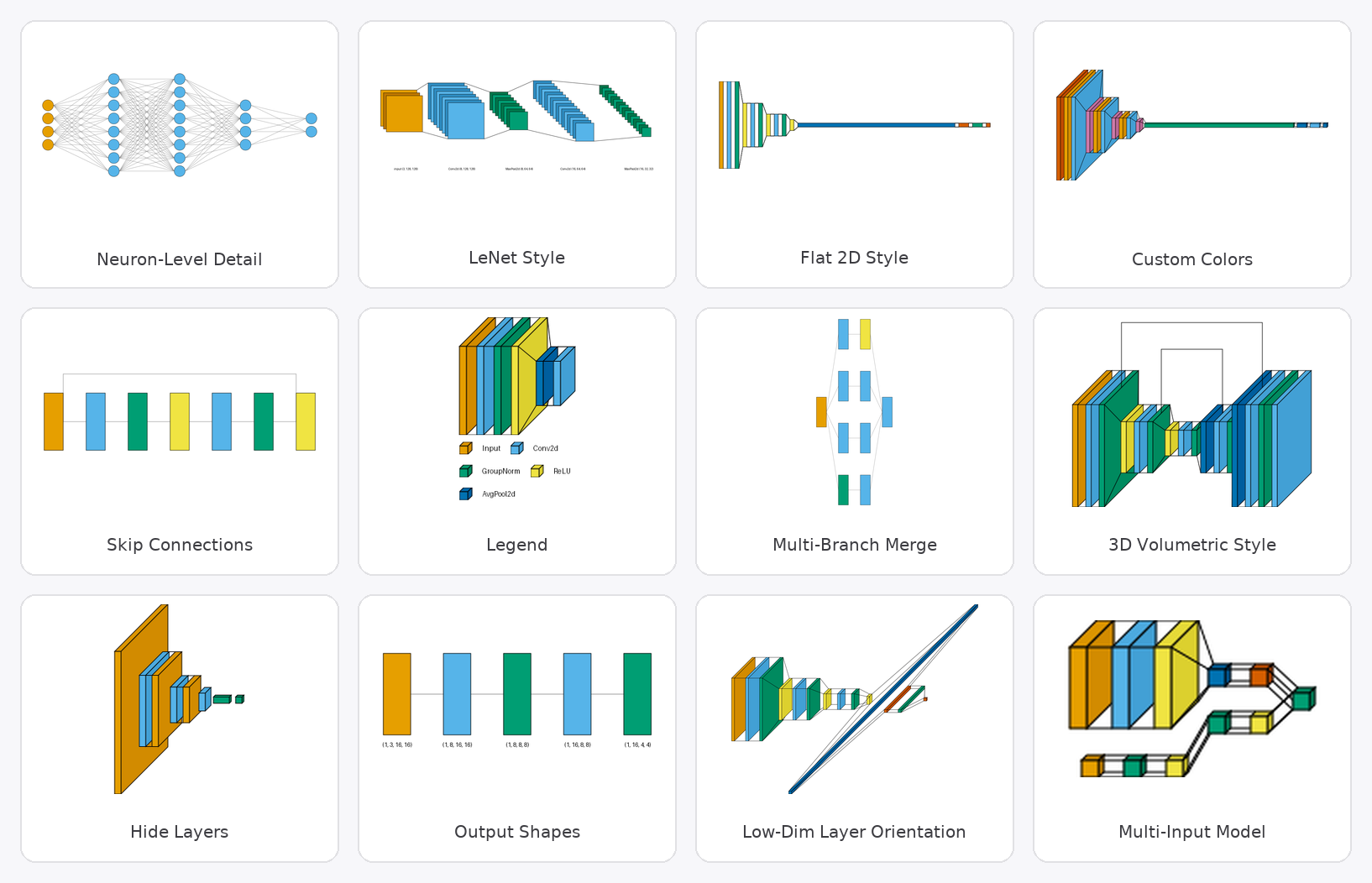
</div>
### Animated Reveal
Every style can also render as an animated GIF, revealing the model one layer/column at a time,
via `visualtorch.animate(model, input_shape, style=...)` - see it in action for
[flow](https://visualtorch.readthedocs.io/en/latest/usage_examples/flow/plot_animated_reveal_flow.html),
[graph](https://visualtorch.readthedocs.io/en/latest/usage_examples/graph/plot_animated_reveal_graph.html), and
[lenet](https://visualtorch.readthedocs.io/en/latest/usage_examples/lenet_style/plot_animated_reveal_lenet_style.html) styles.
<div align="center">

</div>
## Documentation
Online documentation is available at [visualtorch.readthedocs.io](https://visualtorch.readthedocs.io/en/latest/).
The docs include [usage examples](https://visualtorch.readthedocs.io/en/latest/usage_examples/index.html), [API references](https://visualtorch.readthedocs.io/en/latest/markdown/api_references/index.html), and other useful information.
## Installation
See the [Installation page](https://visualtorch.readthedocs.io/en/latest/markdown/get_started/installation.html).
## MCP integration
VisualTorch includes an optional, client-neutral stdio MCP server for generating static PNG
diagrams and animated GIF reveals from PyTorch model source. It exposes capability discovery,
structured output metadata, documentation resources, subprocess timeouts, and all three canonical
styles (`graph`, `flow`, and `lenet`). Install it with `pip install "visualtorch[mcp]"` and see the
[MCP integration guide](https://visualtorch.readthedocs.io/en/latest/markdown/get_started/mcp.html)
for the tool schemas, generic stdio configuration, examples, and trusted-code security boundary.
No client-specific plugin or extension is required.
<!-- mcp-name: io.github.willyfh/visualtorch -->
## Used in Research
VisualTorch has been used in published research, including works published in Nature, IEEE, and MDPI.
See the [Research Showcase page](https://visualtorch.readthedocs.io/en/latest/markdown/showcase/index.html) for the full list.
Used VisualTorch in your research, built something with it, or found a paper that cites it? [Tell us about it](https://github.com/willyfh/visualtorch/discussions) or [open a pull request](https://github.com/willyfh/visualtorch/pulls) to add it directly - we'd love to hear.
## Examples
See the [Usage Examples page](https://visualtorch.readthedocs.io/en/latest/usage_examples/index.html).
## Contributing
Please feel free to send a pull request to contribute to this project by following this [guideline](https://github.com/willyfh/visualtorch/blob/main/CONTRIBUTING.md).
## Releases
See [GOVERNANCE.md](https://github.com/willyfh/visualtorch/blob/main/GOVERNANCE.md#release-process) for release methodology and cadence, and the [PyPI release history](https://pypi.org/project/visualtorch/#history) for past releases.
## License
This poject is available as open source under the terms of the [MIT License](https://github.com/willyfh/visualtorch/blob/main/LICENSE.md).
Originally, this project was based on the [visualkeras](https://github.com/paulgavrikov/visualkeras) (under the MIT license), with additional modifications inspired by [pytorchviz](https://github.com/szagoruyko/pytorchviz), [pytorch-summary](https://github.com/sksq96/pytorch-summary), and [torchview](https://github.com/mert-kurttutan/torchview), all of which are also licensed under the MIT license.
## Citation
Please cite this project in your publications if it helps your research.
**Note:** the paper below describes VisualTorch as of its publication date (2024). The project has
since been substantially refactored, including breaking API changes (see the
[documentation](https://visualtorch.readthedocs.io/en/latest/) for the current API) - the DOI
always resolves to what was actually reviewed and published.
```bibtex
@article{Hendria2024,
doi = {10.21105/joss.06678},
url = {https://doi.org/10.21105/joss.06678},
year = {2024},
publisher = {The Open Journal},
volume = {9},
number = {102},
pages = {6678},
author = {Willy Fitra Hendria and Paul Gavrikov},
title = {VisualTorch: Streamlining Visualization for PyTorch Neural Network Architectures},
journal = {Journal of Open Source Software}
}
```
## Star History
<picture>
<source media="(prefers-color-scheme: dark)" srcset="https://raw.githubusercontent.com/willyfh/visualtorch/assets/docs/source/_static/images/star-history-dark.png" />
<source media="(prefers-color-scheme: light)" srcset="https://raw.githubusercontent.com/willyfh/visualtorch/assets/docs/source/_static/images/star-history-light.png" />
<img alt="Star History Chart" src="https://raw.githubusercontent.com/willyfh/visualtorch/assets/docs/source/_static/images/star-history-light.png" />
</picture>
Lo que la gente pregunta sobre visualtorch
¿Qué es willyfh/visualtorch?
+
willyfh/visualtorch es tools para el ecosistema de Claude AI. VisualTorch aims to help visualize Torch-based neural network architectures. Tiene 312 estrellas en GitHub y se actualizó por última vez today.
¿Cómo se instala visualtorch?
+
Puedes instalar visualtorch clonando el repositorio (https://github.com/willyfh/visualtorch) o siguiendo las instrucciones del README en GitHub. ClaudeWave también te ofrece bloques de instalación rápida en esta misma página.
¿Es seguro usar willyfh/visualtorch?
+
willyfh/visualtorch aún no ha sido auditado por nuestro agente de seguridad. Revisa el repositorio original en GitHub antes de usarlo en producción.
¿Quién mantiene willyfh/visualtorch?
+
willyfh/visualtorch es mantenido por willyfh. La última actividad registrada en GitHub es de today, con 1 issues abiertos.
¿Hay alternativas a visualtorch?
+
Sí. En ClaudeWave puedes explorar tools similares en /categories/tools, ordenados por popularidad o actividad reciente.
Despliega visualtorch en tu cloud
Lleva este repo a producción en minutos. Cada plataforma genera su propio entorno con variables de entorno editables.
¿Mantienes este repo? Añade un badge a tu README
Pega el badge en tu README de GitHub para mostrar que está auditado por ClaudeWave. Cada badge enlaza de vuelta a esta página y muestra el Trust Score actual.
[](https://claudewave.com/repo/willyfh-visualtorch)<a href="https://claudewave.com/repo/willyfh-visualtorch"><img src="https://claudewave.com/api/badge/willyfh-visualtorch" alt="Featured on ClaudeWave: willyfh/visualtorch" width="320" height="64" /></a>Más Tools

A single CLAUDE.md file to improve Claude Code behavior, derived from Andrej Karpathy's observations on LLM coding pitfalls.

An AI SKILL that provide design intelligence for building professional UI/UX multiple platforms

🪨 why use many token when few token do trick — Claude Code skill that cuts 65% of tokens by talking like caveman

CLI proxy that reduces LLM token consumption by 60-90% on common dev commands. Single Rust binary, zero dependencies

The fastest, litest AI Gateway. Rust core with Python SDK. Call 100+ LLM APIs in OpenAI (or native) format with cost tracking, guardrails, load balancing, and logging [Bedrock, Azure, OpenAI, Anthropic, OpenAI, VertexAI, vLLM, Nvidia NIM]

AI agent skill that researches any topic across Reddit, X, YouTube, HN, Polymarket, and the web - then synthesizes a grounded summary