

One design system, in React and in Angular, from one contract. Every component API and the accessibility pattern it binds is a contract a gate holds.
- ✓Open-source license (MIT)
- ✓Actively maintained (<30d)
- ✓Clear description
- ✓Topics declared
- ✓Documented (README)
git clone https://github.com/dravensoft-dev/arena && cp arena/*.md ~/.claude/agents/Subagents overview
# Arena by Dravensoft
**One design system, in React and in Angular, from one contract.**
[](https://www.npmjs.com/package/@dravensoft/arena-react)
[](https://www.npmjs.com/package/@dravensoft/arena-angular)
[](https://www.npmjs.com/package/@dravensoft/arena-react)
[](./LICENSE)
[](https://github.com/dravensoft-dev/arena/actions/workflows/main.yml)
MIT License · Token-driven design system for React, Angular and Tailwind.
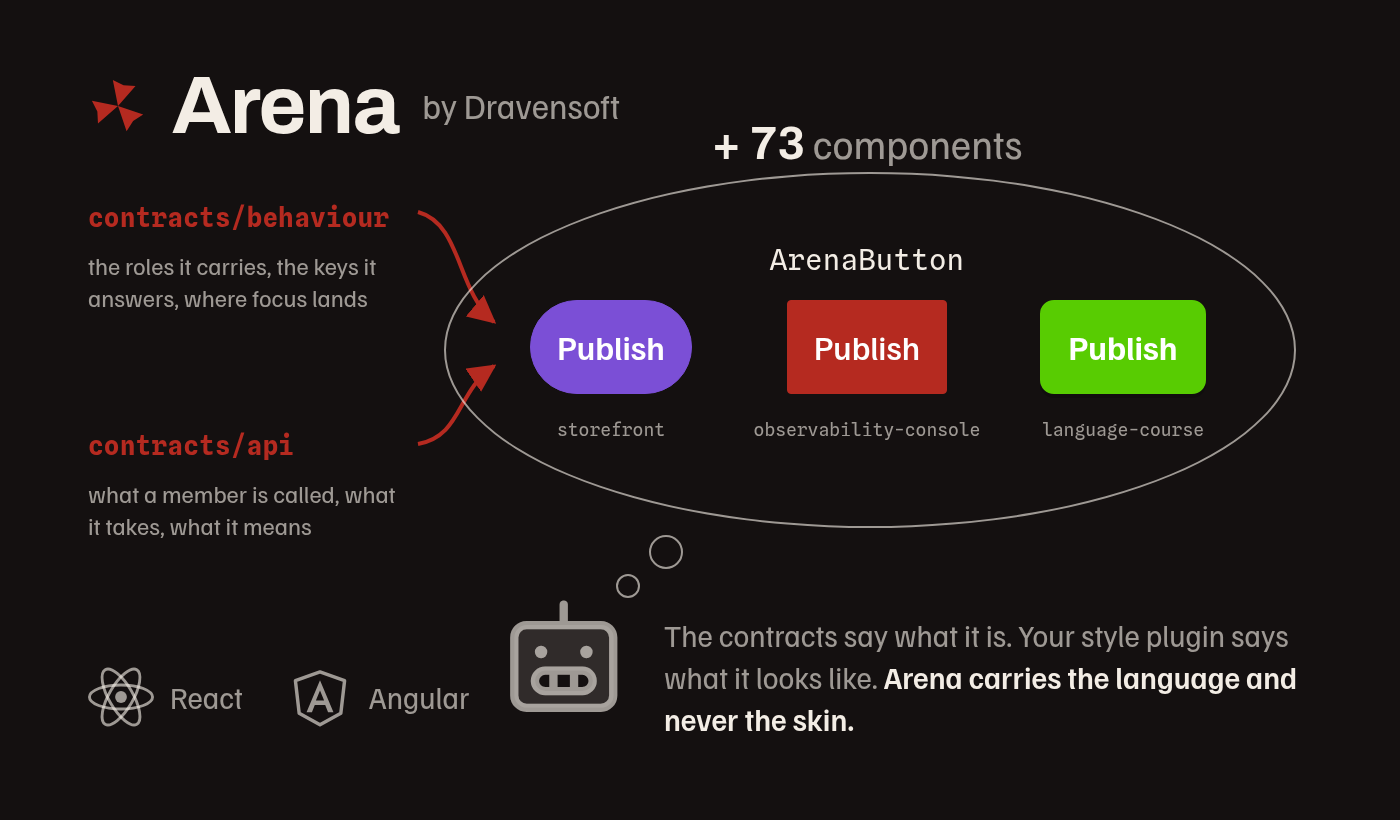
## What you get
**Components with a contracted API.** The same components under both framework
names, rendering the same pixels, over one shared Tailwind layer. What a member
is called, what it takes, what it defaults to and what it means are written in
[`contracts/api/`](./contracts/api/AGENTS.md), and each layer's types and tables
are generated from there, so the two layers cannot drift apart quietly. Every
value a component draws resolves through a design token, so no hex and no bare
pixel sits anywhere inside one.
**Accessibility bound per component instead of audited per release.** Each
component declares which pattern it implements, most of them from the
[WAI-ARIA Authoring Practices](https://www.w3.org/WAI/ARIA/apg/patterns/): the
roles it carries, the keys it answers, where focus lands, what dismisses it. A
requirement it does not meet yet is recorded beside it with its reason, and
`bun run check:behaviour` fails on the day a component stops answering the
pattern it named.
**A style kernel, which is what a project answers to look like itself.** The
questions about shape, space, weight and depth are Arena's; the answers are a
style plugin the project writes, and the appearance Arena installs with is one
such plugin rather than a floor under them. Palettes and fonts sit in an
`arena.config.json`, which the `arena-to-prod` command each package ships turns
into the one stylesheet a package cannot carry: **Arena carries the language and
never the skin**, and none of its own colours reach your build.
**Metadata for a product that has to be found, which most products do not.** The
Angular layer writes the document `<head>` from the routes it is handed, at
`@dravensoft/arena-angular/metadata`: title composition, a description, a
canonical and the `og:*` pair, with no route indexed until it says so. That
import path is a second entry point, so a project that never asks for metadata
never installs the router behind it. React writes no `<head>` at all, and both
layers publish the breadcrumb trail they draw in `schema.org` terms.
## Eight products, drawn twice
[The benches](https://arena.dravensoft.org/web-benches/) are a set of templates that implement
Arena: Calendly, ClickUp, Duolingo, Etsy, Grafana, Instagram, Notion and Superhuman, each mocked
twice, once in React and once in Angular, from one `arena.config.json` and one `design/` directory
per pair. Every half installs Arena from npm and answers a style plugin of its own, so what a pair
shows is a project's appearance rather than Arena's, and the two halves of a pair are the same
screen under both framework names. That address is where they run, and
[`dravensoft-dev/arena-web-benches`](https://github.com/dravensoft-dev/arena-web-benches) is where
they are written.
## Why an agent can operate it
An API is a contract file rather than a paragraph, and so is the pattern a
component binds and the role a style plugin answers; a gate holds the code, the
documentation and the published packages to them. An agent handed this
repository does not guess at Arena: it reads the contract that governs what it is
about to write, and the gate tells it when it got it wrong.
That is also what makes the rules enforceable rather than aspirational. Each of
these is decided in [`contracts/design/AGENTS.md`](./contracts/design/AGENTS.md)
and handed to a builder by
[`skills/design/SKILL.md`](./skills/design/SKILL.md), which states each one in
full and says which of them a gate reads your own sources for.
<!-- @language GENERATED by bun run generate:rules. Edit scripts/lib/arena/language-rules.ts, not this copy. -->
- Tokens are the only styling layer.
- Put no class of your own on an Arena component.
- Danger is outline, never filled.
- One primary accent per view.
- No gradients, on any surface.
- No emoji, in product or in copy.
- Icons are Phosphor class-name strings, never elements and never SVG.
- Never wrap an Arena component in your router's own link.
- An anchor Arena draws splits its activations.
- A press that starts on a control keeps to that control.
- Two themes, dark first.
- A chart carries identity or meaning, never both.
- Copy is English, formal and direct.
- A required member absent is a caller bug.
- No render follows from whether you bound a listener or filled a slot.
- A few components answer with a method rather than a member.
<!-- @language end -->
## Install
```bash
bun add @dravensoft/arena-react # or @dravensoft/arena-angular
```
**That is the whole install.** Phosphor is a peer rather than a second
command, because Arena renders icon class names and never SVG; the layer page
below says which peers each package declares.
Then write `arena.config.json`, run `npx arena-to-prod` (or `bunx`, or
`pnpm exec`), and import what it writes. [`frameworks/react/PACKAGE.md`](./frameworks/react/PACKAGE.md) and
[`frameworks/angular/PACKAGE.md`](./frameworks/angular/PACKAGE.md) are the whole
of it, and they are the pages npm shows.
### Over MCP
```json
{
"mcpServers": {
"arena": { "command": "npx", "args": ["-y", "@dravensoft/arena-mcp"] }
}
}
```
`@dravensoft/arena-mcp` is where the language travels. It serves the router, the
references and every component document to an agent that speaks the Model
Context Protocol, as resources and as tools, and the layer it serves is the one
your project installed. The component packages carry the code, the stylesheets
and the contracts your own markup answers to, and none of the prose.
**A corpus and the components it describes are two packages and two version
numbers**, so they can disagree. `arena_start` reads the version of the Arena
package in your project, compares it with the server's, and says so when the two
differ. Where they do, the components are right and the text is old.
### As a Claude Code plugin
```
/plugin marketplace add dravensoft-dev/arena
/plugin install arena@dravensoft
/reload-plugins
```
**Update**
```
/plugin marketplace update dravensoft # refresh the catalog: learns a new version exists
/plugin update arena@dravensoft # update the plugin you actually have
/reload-plugins # apply it to the running session
```
**A version means one commit.** Each release is served from its git tag, with
the marketplace entry pinning `source.ref` to `vX.Y.Z`.
### As a standalone Agent Skill
Hand any agent [`skills/design/SKILL.md`](./skills/design/SKILL.md). It is the
router, and it answers each question with one file. **It routes over this tree**,
so an agent handed the file alone has the questions and reaches the answers by
URL; one handed the clone or the plugin reaches them by path.
**A component package is code, and the language reaches an agent by one of the
three routes above.** Install the MCP server, install the plugin, or hand over
the skill, and the agent gets the guidelines, the contracts and every component's
usage document, which is what turns "integrate Arena" into a task it finishes on
its own.
## See it
**[arena.dravensoft.org](https://arena.dravensoft.org)** carries the design
guidelines, the kitchen sink, and a playground page for every component, with no
clone and nothing to install.
The same pages come up locally with `bun run demos`, from the same list, and
[`scripts/build/AGENTS.md`](./scripts/build/AGENTS.md) says what a fresh clone
has to build before they mean anything.
**An agent reads [`llms.txt`](https://arena.dravensoft.org/llms.txt) first**, which
routes to the rules of the language and then to one corpus per framework,
[React](https://arena.dravensoft.org/llms-react.txt) and
[Angular](https://arena.dravensoft.org/llms-angular.txt). They are separate on purpose: every
component ships under both names and the two documents are not interchangeable.
## Dependencies
- **Fonts are self-hosted, and no CDN request is made.** Arena ships the Archivo
/ Familjen Grotesk / Spline Sans Mono `.woff2` binaries in `assets/fonts/`, and
`contracts/design-generated/fonts.generated.css` declares them with
`@font-face`, so they load from the same origin as the page that reads them. A
package consumer names their own three families in `arena.config.json`, where
`src` is either a stylesheet URL or a binary they host.
- **Icons are [Phosphor Icons](https://phosphoricons.com) (MIT)**, and are not
bundled. **Install the official package by default**, either
`@phosphor-icons/web` (webfont) or `@phosphor-icons/react`, for full weight and
tree-shaking flexibility. The CDN is a prototype-only convenience, not the
default. See [Iconography](./contracts/design/AGENTS.md#iconography).
## Which version am I getting
The two packages and the plugin do not always carry the same number, because a
package publishes only when something it ships changed.
[`.giWhat people ask about arena
What is dravensoft-dev/arena?
+
dravensoft-dev/arena is subagents for the Claude AI ecosystem. One design system, in React and in Angular, from one contract. Every component API and the accessibility pattern it binds is a contract a gate holds. It has 2 GitHub stars and its last recorded update is dated 2026-09-10.
How do I install arena?
+
You can install arena by cloning the repository (https://github.com/dravensoft-dev/arena) or following the README instructions on GitHub. ClaudeWave also provides quick install blocks on this page.
Is dravensoft-dev/arena safe to use?
+
Our security agent has analyzed dravensoft-dev/arena and assigned a Trust Score of 95/100 (tier: Verified). See the full breakdown of passed checks and flags on this page.
Who maintains dravensoft-dev/arena?
+
dravensoft-dev/arena is maintained by dravensoft-dev. The last recorded GitHub activity is dated 2026-09-10, with 0 open issues.
Are there alternatives to arena?
+
Yes. On ClaudeWave you can browse similar subagents at /categories/agents, sorted by popularity or recent activity.
Deploy arena to your cloud
Ship this repo to production in minutes. Each platform spins up its own environment with editable env vars.
Maintain this repo? Add a badge to your README
Drop the badge into your GitHub README to show it's tracked on ClaudeWave. Each badge links back to this page and reflects the live Trust Score.
[](https://claudewave.com/repo/dravensoft-dev-arena)<a href="https://claudewave.com/repo/dravensoft-dev-arena"><img src="https://claudewave.com/api/badge/dravensoft-dev-arena" alt="Featured on ClaudeWave: dravensoft-dev/arena" width="320" height="64" /></a>More Subagents

The agent harness performance optimization system. Skills, instincts, memory, security, and research-first development for Claude Code, Codex, Opencode, Cursor and beyond.

The agent that grows with you

Java 面试 & 后端通用面试指南,覆盖计算机基础、数据库、分布式、高并发、系统设计与 AI 应用开发

Build Agentic workflows, RAG pipelines, with rich AI model and tool support on one collaborative workspace. Deploy on cloud, VPC, or self-hosted, so teams move from prototype to production without rebuilding the stack.

The agent engineering platform.

Makes your AI agent think like the laziest senior dev in the room. The best code is the code you never wrote.