

Open-source Power BI MCP to build, audit and repair Desktop models and PBIP reports with DAX, TOM, TMDL and PBIR.
- ✓Open-source license (Apache-2.0)
- ✓Actively maintained (<30d)
- ✓Clear description
- ✓Topics declared
- ✓Documented (README)
/plugin marketplace add HorizunGroup/horizun-pbi-mcp
/plugin install horizun-pbi-mcpPlugins overview
# Horizun PBI MCP [](https://github.com/HorizunGroup/horizun-pbi-mcp/actions/workflows/ci.yml) [](https://pypi.org/project/horizun-pbi-mcp/) [](https://pypi.org/project/horizun-pbi-mcp/) [](LICENSE) **Build and fix Power BI reports by describing what you want.** Ask in plain language; the server runs the DAX, edits the model, writes the report pages — and checks its own work afterwards. ### No licence, no API key, no paid plan It runs as a **local process on your own Windows machine**, so the free apps are enough: install it in **ChatGPT Desktop** or **Claude Desktop** on their free tiers and start asking. No OpenAI or Anthropic API key, no subscription, no server of ours in the middle — and Power BI Desktop is free as well. One click installs it and it prepares its own runtime: no Python, no JSON to edit. 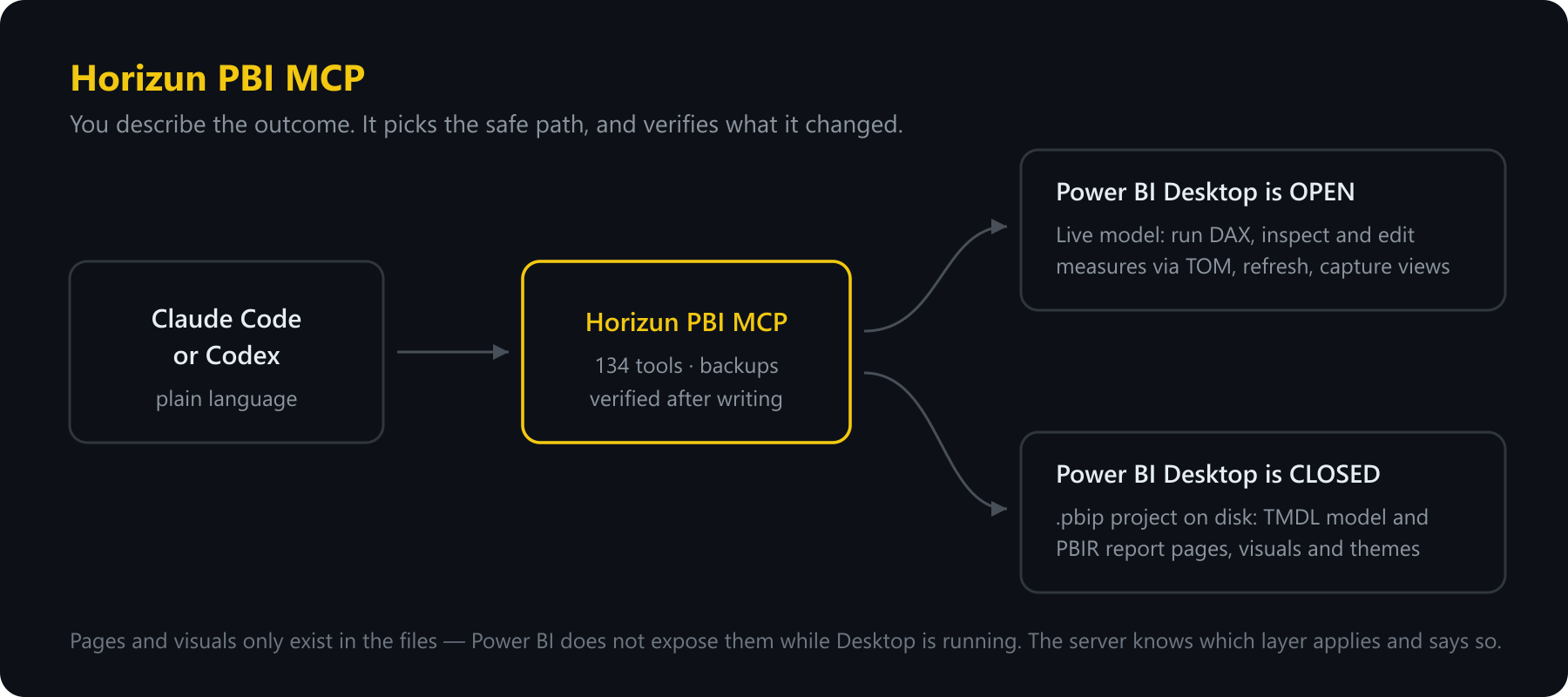 **v2.1.2** · 139 tools · Windows · ChatGPT Desktop Free · Claude Desktop Free · Claude Code · Codex New to the project? Start with [what this Power BI MCP is, when to use it, and what it deliberately does not do](docs/POWER_BI_MCP.md). ## Install No repository clone, manual DLL download or `.mcp.json` editing is required. Pick the line that matches you. ### ChatGPT Desktop Free Run the verified one-paste installer from [`docs/INSTALL.md`](docs/INSTALL.md), restart ChatGPT Desktop, then open **Plugins → Personal** and install **Horizun PBI MCP**. No OpenAI API key is required. ### Claude Desktop Free Download the `.mcpb` from the [latest release](https://github.com/HorizunGroup/horizun-pbi-mcp/releases/latest) and double-click it. Claude Desktop supplies the bootstrap runtime; no Claude Code install or JSON editing is required. It will say the extension is **not verified by Anthropic** — what it says about anything installed outside its own directory — and let you continue. ### Claude Code ```powershell claude plugin marketplace add HorizunGroup/horizun-pbi-mcp claude plugin install horizun-pbi-mcp@horizun ``` ### Codex ```powershell codex plugin marketplace add HorizunGroup/horizun-pbi-mcp ``` Then open `/plugins`, pick the **Horizun** marketplace and install `horizun-pbi-mcp`. ### Desktop or Code? Same server, same 139 tools, same local runtime — install both and they share it. Pick by what you are doing: **Claude Desktop** to *use* Power BI, in chat, one click, free tier. **Claude Code** to *build* — it adds the terminal, git and your repo, and loads tool schemas on demand instead of all at once. On a new PC, the [verified one-paste installer](docs/INSTALL.md) prepares the prerequisites without administrator rights. First setup takes a few minutes: run `pbi_install_status` until `ready`, restart once, and confirm the 139 `pbi_*` tools appear. ## Your first minute 1. Open Power BI Desktop with any report. 2. Ask: *"List the Power BI models that are open and connect to the first one."* 3. Ask: *"Run a read-only DAX query that returns revenue by month for this year."* If step 2 answers, everything works. ## Things worth asking for ```text Audit this PBIP project and explain the highest-risk issues before changing anything. ``` ```text This measure returns blank for December. Find out why. ``` ```text Create a report page from this specification, validate it, and show me the layout. ``` ```text Document every measure in the model and export it to Excel. ``` ## What it provides | Area | Capabilities | |---|---| | Live model | Discover Desktop sessions, run DAX, inspect metadata, refresh, and manage measures through TOM | | Semantic model | Read and edit TMDL tables, columns, measures, relationships, roles and calculation groups | | Report authoring | Create pages and visuals, clone templates, arrange layouts, apply themes, bookmarks and interactions | | Conversion | Convert `.pbix` to `.pbip`, migrate supported structures and validate the result | | Quality | Audit models and reports, document schemas, detect broken references and normalize report structures | | Delivery | Export verified PDF, Word, Excel and PowerPoint artifacts; ingest SharePoint data read-only | See the [tool catalog](docs/TOOL_CATALOG.md) for all 139 tools and their risk classifications. ## Why it is safe to point at real work - Local-first: Power BI Desktop communication stays on `localhost`. - No telemetry, and the MCP server needs no account. - Project writes stay inside the active project directory. - Every project write makes a backup and is re-read to confirm it landed. - Destructive tools require `confirm=true`. - JSON writes are atomic; invalid JSON is never written over good JSON. - Downloaded runtime components are version-pinned and SHA-256 verified. - Logs go to stderr or files, so stdout stays a clean JSON-RPC channel. Full guarantees and failure behavior: [security model](docs/SECURITY.md) and [recovery guide](docs/RECOVERY.md). Report vulnerabilities privately as described in [SECURITY.md](SECURITY.md). ## Requirements - Windows 10 or 11. - Python 3.10 or newer. - Power BI Desktop — only for the live layer (DAX, refresh, capture, render checks). - A `.pbip` project with PBIR enabled, for report-file authoring. - Node.js 20+ only for the optional Microsoft PBIR validator. Claude Code, Codex and Power BI Desktop are external programs; this project does not install them. Without Desktop the `.pbip` tools still work — the live tools do not. ## Known limits - Power BI does not expose pages or visuals through its live local endpoint, so those are edited in PBIR files while Desktop is safely closed. - `mode="both"` is disabled for dual live/disk writes: Desktop being open and a PBIP project being safe to edit are mutually exclusive states. - The server does not publish to or refresh the Power BI Service. - Three PBIR schemas referenced by Power BI are not published by Microsoft; affected writes fail closed instead of guessing. ## Documentation | Document | Purpose | |---|---| | [Installation](docs/INSTALL.md) | Setup, repair, offline installation and MCP client registration | | [Tutorial](docs/TUTORIAL.md) | First connection through report authoring | | [Power BI MCP overview](docs/POWER_BI_MCP.md) | Use cases, boundaries, safety and first workflow | | [Tool catalog](docs/TOOL_CATALOG.md) | All tools, grouped by capability and risk | | [Architecture](docs/ARCHITECTURE.md) | Components, boundaries and invariants | | [Security](docs/SECURITY.md) | Threat model and operational guarantees | | [Validation](docs/VALIDATION.md) | TMDL/PBIR validation layers and known limits | | [Migration guide](docs/MIGRACION_1x_A_2.0.md) | Breaking changes from 1.x to 2.0 | | [Contributing](CONTRIBUTING.md) | Development workflow and pull-request requirements | ## Development ```powershell git clone https://github.com/HorizunGroup/horizun-pbi-mcp.git cd horizun-pbi-mcp python -m pip install -e . python scripts/fetch_libs.py python scripts/fetch_pbir_schemas.py python scripts/doctor.py ``` Before opening a pull request: ```powershell python -m pytest -q python scripts/doctor.py python -m tests.contract_utils ``` The MCP contract is frozen and checked against `tests/golden/tools_v1.json`. Real `.pbix`, `.pbip`, credentials, DLLs, outputs and backups are never committed. See [AGENTS.md](AGENTS.md) for the repository invariants. ## License Apache License 2.0. See [LICENSE](LICENSE) and [NOTICE](NOTICE). ## MCP Registry This package is the one published under the server name below. The registry reads this line from the README of the **PyPI package** to confirm that whoever publishes the metadata also owns the package, so it has to live here rather than in `.mcp/server.json` alone. ``` mcp-name: io.github.HorizunGroup/horizun-pbi-mcp ```
What people ask about horizun-pbi-mcp
What is HorizunGroup/horizun-pbi-mcp?
+
HorizunGroup/horizun-pbi-mcp is plugins for the Claude AI ecosystem. Open-source Power BI MCP to build, audit and repair Desktop models and PBIP reports with DAX, TOM, TMDL and PBIR. It has 29 GitHub stars and its last recorded update is dated 2026-10-04.
How do I install horizun-pbi-mcp?
+
You can install horizun-pbi-mcp by cloning the repository (https://github.com/HorizunGroup/horizun-pbi-mcp) or following the README instructions on GitHub. ClaudeWave also provides quick install blocks on this page.
Is HorizunGroup/horizun-pbi-mcp safe to use?
+
Our security agent has analyzed HorizunGroup/horizun-pbi-mcp and assigned a Trust Score of 95/100 (tier: Verified). See the full breakdown of passed checks and flags on this page.
Who maintains HorizunGroup/horizun-pbi-mcp?
+
HorizunGroup/horizun-pbi-mcp is maintained by HorizunGroup. The last recorded GitHub activity is dated 2026-10-04, with 3 open issues.
Are there alternatives to horizun-pbi-mcp?
+
Yes. On ClaudeWave you can browse similar plugins at /categories/plugins, sorted by popularity or recent activity.
Deploy horizun-pbi-mcp to your cloud
Ship this repo to production in minutes. Each platform spins up its own environment with editable env vars.
Maintain this repo? Add a badge to your README
Drop the badge into your GitHub README to show it's tracked on ClaudeWave. Each badge links back to this page and reflects the live Trust Score.
[](https://claudewave.com/repo/horizungroup-horizun-pbi-mcp)<a href="https://claudewave.com/repo/horizungroup-horizun-pbi-mcp"><img src="https://claudewave.com/api/badge/horizungroup-horizun-pbi-mcp" alt="Featured on ClaudeWave: HorizunGroup/horizun-pbi-mcp" width="320" height="64" /></a>More Plugins

Claude Code is an agentic coding tool that lives in your terminal, understands your codebase, and helps you code faster by executing routine tasks, explaining complex code, and handling git workflows - all through natural language commands.

AI agent skill that researches any topic across Reddit, X, YouTube, HN, Polymarket, and the web - then synthesizes a grounded summary

Write HTML. Render video. Built for agents.

Agent skill that removes signs of AI-generated writing from text

Academic Research Skills for Claude Code: research → write → review → revise → finalize

Create beautiful slides on the web using a coding agent's frontend skills