

Multi-harness agentic plugin marketplace for Claude Code, Codex CLI, Cursor, OpenCode, GitHub Copilot, and Gemini CLI
The wshobson/agents repository is a multi-harness agentic plugin marketplace containing 84 plugins, 192 agents, 156 skills, 102 slash commands, and 16 orchestrators built primarily for Claude Code but also consumed natively by OpenAI Codex CLI, Cursor, OpenCode, Gemini CLI, and GitHub Copilot. All components are authored in Markdown from a single source in the `plugins/` directory, with per-harness adapters generating idiomatic artifacts for each tool rather than generic translations. In Claude Code, plugins install via `/plugin install` commands and load only their own components into context, keeping token usage scoped. Domain coverage spans architecture, backend languages, infrastructure, security, ML, documentation, and SEO, with agents assigned to one of four model tiers ranging from Opus for production-critical work down to Haiku for fast operational tasks. A built-in `plugin-eval` framework provides three-layer quality certification combining static structural checks, LLM-based semantic scoring, and Monte Carlo reliability testing. The primary audience is developers who want composable, production-ready agentic workflows across multiple AI coding tools without maintaining separate configuration trees.
Large curated collection of Claude Code agents, skills, workflows and slash commands for orchestrated automation.
- ✓Open-source license (MIT)
- ✓Actively maintained (<30d)
- ✓Healthy fork ratio
- ✓Clear description
- ✓Topics declared
- ✓Documented (README)
git clone https://github.com/wshobson/agents && cp agents/*.md ~/.claude/agents/24 items in this repository
Test web applications with screen readers including VoiceOver, NVDA, and JAWS. Use when validating screen reader compatibility, debugging accessibility issues, or ensuring assistive technology support.
Conduct WCAG 2.2 accessibility audits with automated testing, manual verification, and remediation guidance. Use when auditing websites for accessibility, fixing WCAG violations, or implementing accessible design patterns.
Coordinate parallel code reviews across multiple quality dimensions with finding deduplication, severity calibration, and consolidated reporting. Use this skill when organizing multi-reviewer code reviews, calibrating finding severity, or consolidating review results.
Debug complex issues using competing hypotheses with parallel investigation, evidence collection, and root cause arbitration. Use this skill when debugging bugs with multiple potential causes, performing root cause analysis, or organizing parallel investigation workflows.
Coordinate parallel feature development with file ownership strategies, conflict avoidance rules, and integration patterns for multi-agent implementation. Use this skill when decomposing a large feature into independent work streams, when two or more agents need to implement different layers of the same system simultaneously, when establishing file ownership to prevent merge conflicts in a shared codebase, when designing interface contracts so parallel implementers can build against each other's APIs before they are ready, or when deciding whether to use vertical slices versus horizontal layers for a full-stack feature.
Decompose complex tasks, design dependency graphs, and coordinate multi-agent work with proper task descriptions and workload balancing. Use this skill when breaking down work for agent teams, managing task dependencies, or monitoring team progress.
Structured messaging protocols for agent team communication including message type selection, plan approval, shutdown procedures, and anti-patterns to avoid. Use this skill when establishing communication norms for a newly spawned team, when deciding whether to send a direct message or a broadcast, when a team-lead needs to review and approve an implementer's plan before work begins, when orchestrating a graceful team shutdown after all tasks are complete, or when debugging why teammates are not coordinating correctly at integration points.
Design optimal agent team compositions with sizing heuristics, preset configurations, and agent type selection. Use this skill when deciding how many agents to spawn for a task, when choosing between a review team versus a feature team versus a debug team, when selecting the correct subagent_type for each role to ensure agents have the tools they need, when configuring display modes (tmux, iTerm2, in-process) for a CI or local environment, or when building a custom team composition for a non-standard workflow such as a migration or security audit.
Create production-ready FastAPI projects with async patterns, dependency injection, and comprehensive error handling. Use when building new FastAPI applications or setting up backend API projects.
Master REST and GraphQL API design principles to build intuitive, scalable, and maintainable APIs that delight developers. Use when designing new APIs, reviewing API specifications, or establishing API design standards.
Implement proven backend architecture patterns including Clean Architecture, Hexagonal Architecture, and Domain-Driven Design. Use this skill when designing clean architecture for a new microservice, when refactoring a monolith to use bounded contexts, when implementing hexagonal or onion architecture patterns, or when debugging dependency cycles between application layers.
Implement Command Query Responsibility Segregation for scalable architectures. Use when separating read and write models, optimizing query performance, or building event-sourced systems.
Design and implement event stores for event-sourced systems. Use when building event sourcing infrastructure, choosing event store technologies, or implementing event persistence patterns.
Design microservices architectures with service boundaries, event-driven communication, and resilience patterns. Use when building distributed systems, decomposing monoliths, or implementing microservices.
Build read models and projections from event streams. Use when implementing CQRS read sides, building materialized views, or optimizing query performance in event-sourced systems.
Implement saga patterns for distributed transactions and cross-aggregate workflows. Use this skill when implementing distributed transactions across microservices where 2PC is unavailable, designing compensating actions for failed order workflows that span inventory, payment, and shipping services, building event-driven saga coordinators for travel booking systems that must roll back hotel, flight, and car rental reservations atomically, or debugging stuck saga states in production where compensation steps never complete.
Test Temporal workflows with pytest, time-skipping, and mocking strategies. Covers unit testing, integration testing, replay testing, and local development setup. Use when implementing Temporal workflow tests or debugging test failures.
Design durable workflows with Temporal for distributed systems. Covers workflow vs activity separation, saga patterns, state management, and determinism constraints. Use when building long-running processes, distributed transactions, or microservice orchestration.
Configure a PreToolUse hook to prevent AI agents from skipping git pre-commit hooks with --no-verify and other bypass flags. Use when setting up Claude Code projects that enforce commit quality gates.
Implement DeFi protocols with production-ready templates for staking, AMMs, governance, and flash loans. Use when building decentralized finance applications or smart contract protocols.
Implement NFT standards (ERC-721, ERC-1155) with proper metadata handling, minting strategies, and marketplace integration. Use when creating NFT contracts, building NFT marketplaces, or implementing digital asset systems.
Master smart contract security best practices to prevent common vulnerabilities and implement secure Solidity patterns. Use when writing smart contracts, auditing existing contracts, or implementing security measures for blockchain applications.
Test smart contracts comprehensively using Hardhat and Foundry with unit tests, integration tests, and mainnet forking. Use when testing Solidity contracts, setting up blockchain test suites, or validating DeFi protocols.
Subagents overview
# Agentic Plugin Marketplace > Production-ready agentic workflow building blocks: **94 plugins**, **203 agents**, > **175 skills**, **109 commands** — built for Claude Code and consumed natively by > OpenAI Codex CLI, Cursor, OpenCode, Gemini CLI, and GitHub Copilot from a single Markdown source. [](#claude-code) [](docs/harnesses.md) [](docs/harnesses.md) [](docs/harnesses.md) [](GEMINI.md) [](docs/harnesses.md) > [!NOTE] > One source-of-truth (`plugins/`), five harnesses. Each harness gets idiomatic, > harness-native artifacts — not lowest-common-denominator translations. > See [docs/harnesses.md](docs/harnesses.md) for the capability matrix. ## Quick start Pick your harness: ### Claude Code ```bash /plugin marketplace add wshobson/agents /plugin install python-development # or any of 94 plugins ``` [→ Full Claude Code setup, troubleshooting, and plugin catalog](docs/usage.md) ### Codex CLI · Cursor · OpenCode · Gemini CLI · Copilot Codex and Cursor install natively from the committed registries (which point at the source `plugins/`): ```bash npx codex-marketplace add wshobson/agents # Codex; then install individual plugins # Cursor: add the marketplace, then `/plugin install <name>` (reads .cursor-plugin/ + source) ``` Gemini and OpenCode install via clone + generate (the transformed trees are gitignored): ```bash gh repo clone wshobson/agents ~/agents && cd ~/agents make generate HARNESS=gemini && gemini extensions install . # Gemini make install-opencode # OpenCode (runs generate + symlinks) ``` Setup details and per-harness gotchas: [docs/harnesses.md](docs/harnesses.md). Gemini-specific setup: [GEMINI.md](GEMINI.md) (also auto-loaded by Gemini CLI). ## What's inside | | Count | What it is | |---|---:|---| | **Plugins** | 94 | Granular, single-purpose installable units (90 local + 4 external via git-subdir) | | **Agents** | 203 | Domain experts (architecture, languages, infra, security, data, ML, docs, business, SEO) | | **Skills** | 175 | Modular knowledge packages with progressive disclosure (load when activated) | | **Commands** | 109 | Slash commands: scaffolding, security scans, test gen, infrastructure setup | | **Orchestrators** | 16 | Multi-agent coordination workflows (full-stack, security, ML, incident response) | Browse the catalog: [docs/plugins.md](docs/plugins.md) · [docs/agents.md](docs/agents.md) · [docs/agent-skills.md](docs/agent-skills.md) ## How it works Each plugin is isolated and composable: agents, commands, and skills are auto-discovered from directory structure. **Installing a plugin loads only its components into context** — not the whole marketplace. ``` plugins/python-development/ ├── .claude-plugin/plugin.json ├── agents/ # 3 Python agents (python-pro, django-pro, fastapi-pro) ├── commands/ # 1 scaffolding command └── skills/ # 16 specialized skills (async, testing, packaging, …) ``` Tiered model strategy: | Tier | Model | Use | |---|---|---| | 0 | Fable 5 | Longest-horizon autonomous work — large migrations, multi-hour runs (opt-in, premium cost) | | 1 | Opus | Architecture, security, code review, production-critical | | 2 | inherit | User-chosen — backend, frontend, AI/ML, specialized | | 3 | Sonnet | Docs, testing, debugging, API references | | 4 | Haiku | Fast operational tasks, SEO, deployment, content | [→ Model configuration details](docs/agents.md#model-configuration) ## Multi-harness support This marketplace ships to five agentic harnesses from one Markdown source. Each adapter emits harness-native artifacts (not lowest-common-denominator translations): | Harness | Generates | Notes | |---|---|---| | **Claude Code** | (source-of-truth) | Native `marketplace.json` + `plugins/` | | **Codex CLI** | `.agents/plugins/marketplace.json` + `plugins/*/.codex-plugin/plugin.json` (committed); `.codex/skills/`, `.codex/agents/` (gitignored) | 8 KB skill cap respected; commands → skills | | **Cursor** | `.cursor-plugin/`, `.cursor/rules/` | Thin marketplace + curated rules; reuses `.claude/` | | **OpenCode** | `.opencode/agents/`, `.opencode/commands/`, `.opencode/skills/` | `permission:` block from `tools:` allowlist; OpenCode-safe skill names | | **Gemini CLI** | `skills/`, `agents/`, `commands/` (TOML) | Native skills + subagents (April 2026 spec) | | **Copilot** | `.copilot/agents/`, `.copilot/skills/`, `.copilot/commands/` | Markdown agent profiles + SKILL.md skills + commands-as-skills; model maps to native Claude models | ```bash make generate-all # all five make validate # structural checks make garden # drift / dead-link / cap detection ``` Codex and Cursor install from source via committed registries; Gemini and OpenCode install via clone + `make`. [→ Full capability matrix and per-harness deep-dives](docs/harnesses.md) ## Quality evaluation [`plugin-eval`](plugins/plugin-eval/) is a three-layer evaluation framework for measuring and certifying plugin/skill quality: - **Static** — deterministic structural analysis (<2s, free) - **LLM Judge** — semantic evaluation across 4 dimensions (~30s, Haiku + Sonnet) - **Monte Carlo** — statistical reliability via 50-100 simulated runs (~2-5 min) ```bash uv run plugin-eval score path/to/skill --depth quick uv run plugin-eval certify path/to/skill ``` [→ PluginEval framework documentation](docs/plugin-eval.md) ## Documentation map Detail lives in `docs/`. Read in this order: - **[docs/plugins.md](docs/plugins.md)** — full catalog of all 94 plugins - **[docs/agents.md](docs/agents.md)** — all 203 agents by category - **[docs/agent-skills.md](docs/agent-skills.md)** — 175 skills with progressive disclosure - **[docs/usage.md](docs/usage.md)** — commands, workflows, examples - **[docs/architecture.md](docs/architecture.md)** — design principles - **[docs/harnesses.md](docs/harnesses.md)** — cross-harness capability matrix - **[docs/authoring.md](docs/authoring.md)** — portable-content style guide - **[docs/plugin-eval.md](docs/plugin-eval.md)** — quality evaluation framework - **[docs/round-trip-results.md](docs/round-trip-results.md)** — real-CLI verification recipes Gemini-specific setup: [GEMINI.md](GEMINI.md). All other harness setup, capability deltas, and gotchas live in [docs/harnesses.md](docs/harnesses.md). Contributing: [CONTRIBUTING.md](CONTRIBUTING.md) · Authoring: [docs/authoring.md](docs/authoring.md) ## External Memory Integration [Pensyve](https://github.com/major7apps/pensyve) is included as an external `git-subdir` entry for Claude Code. Pensyve also maintains direct upstream integrations for this marketplace's other supported harnesses. | Harness | Pensyve integration | |---|---| | Claude Code | `/plugin install pensyve` from this marketplace (`integrations/claude-code`) | | Codex CLI | [integrations/codex-plugin](https://github.com/major7apps/pensyve/tree/main/integrations/codex-plugin) | | Cursor | [integrations/cursor](https://github.com/major7apps/pensyve/tree/main/integrations/cursor) | | OpenCode | [integrations/opencode-plugin](https://github.com/major7apps/pensyve/tree/main/integrations/opencode-plugin) | | Gemini CLI | `gemini extensions install https://github.com/major7apps/pensyve` | | Copilot | `.copilot/` in repo root or `~/.copilot/` via `make install-copilot` | ## License MIT — see [LICENSE](LICENSE). ## Star history [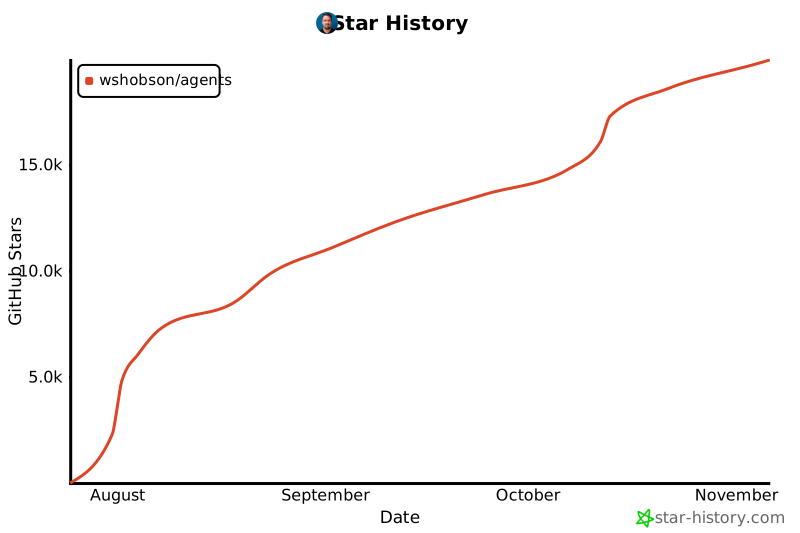](https://www.star-history.com/#wshobson/agents&type=date&legend=top-left)
What people ask about agents
What is wshobson/agents?
+
wshobson/agents is subagents for the Claude AI ecosystem. Multi-harness agentic plugin marketplace for Claude Code, Codex CLI, Cursor, OpenCode, GitHub Copilot, and Gemini CLI It has 38.3k GitHub stars and was last updated 5d ago.
How do I install agents?
+
You can install agents by cloning the repository (https://github.com/wshobson/agents) or following the README instructions on GitHub. ClaudeWave also provides quick install blocks on this page.
Is wshobson/agents safe to use?
+
Our security agent has analyzed wshobson/agents and assigned a Trust Score of 89/100 (tier: Trusted). See the full breakdown of passed checks and flags on this page.
Who maintains wshobson/agents?
+
wshobson/agents is maintained by wshobson. The last recorded GitHub activity is from 5d ago, with 8 open issues.
Are there alternatives to agents?
+
Yes. On ClaudeWave you can browse similar subagents at /categories/agents, sorted by popularity or recent activity.
Deploy agents to your cloud
Ship this repo to production in minutes. Each platform spins up its own environment with editable env vars.
Maintain this repo? Add a badge to your README
Drop the badge into your GitHub README to show it's tracked on ClaudeWave. Each badge links back to this page and reflects the live Trust Score.
[](https://claudewave.com/repo/wshobson-agents)<a href="https://claudewave.com/repo/wshobson-agents"><img src="https://claudewave.com/api/badge/wshobson-agents" alt="Featured on ClaudeWave: wshobson/agents" width="320" height="64" /></a>More Subagents

The agent harness performance optimization system. Skills, instincts, memory, security, and research-first development for Claude Code, Codex, Opencode, Cursor and beyond.

The agent that grows with you

Java 面试 & 后端通用面试指南,覆盖计算机基础、数据库、分布式、高并发、系统设计与 AI 应用开发

Build Agentic workflows, RAG pipelines, with rich AI model and tool support on one collaborative workspace. Deploy on cloud, VPC, or self-hosted, so teams move from prototype to production without rebuilding the stack.

The agent engineering platform.

Turn any codebase, with its docs, SQL schemas, configs, and PDFs, into a queryable knowledge graph. A /graphify skill for Claude Code, Cursor, Codex, and Gemini CLI: local deterministic AST parsing, every edge explained, no vector store.