

Persistent, local-first memory for Claude Code, Codex, Cursor, Gemini CLI, OpenClaw and any MCP agent — cited Markdown, bitemporal history, no hosted account.
claude mcp add talamus -- npx -y skills{
"mcpServers": {
"talamus": {
"command": "npx",
"args": ["-y", "skills"]
}
}
}MCP Servers overview
# Talamus <!-- mcp-name: io.github.ampres-ai/talamus --> [](https://github.com/ampres-ai/talamus/actions/workflows/ci.yml) [](https://pypi.org/project/talamus/) [](https://registry.modelcontextprotocol.io/v0.1/servers?search=io.github.ampres-ai%2Ftalamus) [](https://smithery.ai/servers/ampres-ai/talamus) [](https://skills.sh/ampres-ai/talamus)   **Your coding agent forgets why a decision was made as soon as the session ends.** Talamus keeps the decisions, evidence, and corrections worth remembering as ordinary Markdown, then gives Claude Code, Codex, Cursor, Gemini CLI, and any MCP agent cited recall in the next session. **No hosted account. No telemetry. No required embeddings. Plain search stays on your machine; LLM-backed actions use only the engine you choose.** Try the whole local retrieval loop first — no persistent install, account, LLM, or hook, and no files written outside `./talamus-demo`: ```bash uvx --from talamus talamus demo --root ./talamus-demo uvx --from talamus talamus search "embedding" --root ./talamus-demo uvx --from talamus talamus read "Embedding" --root ./talamus-demo ``` If local, inspectable agent memory is useful to you, [star Talamus on GitHub](https://github.com/ampres-ai/talamus) — it helps other builders discover a local-first alternative. 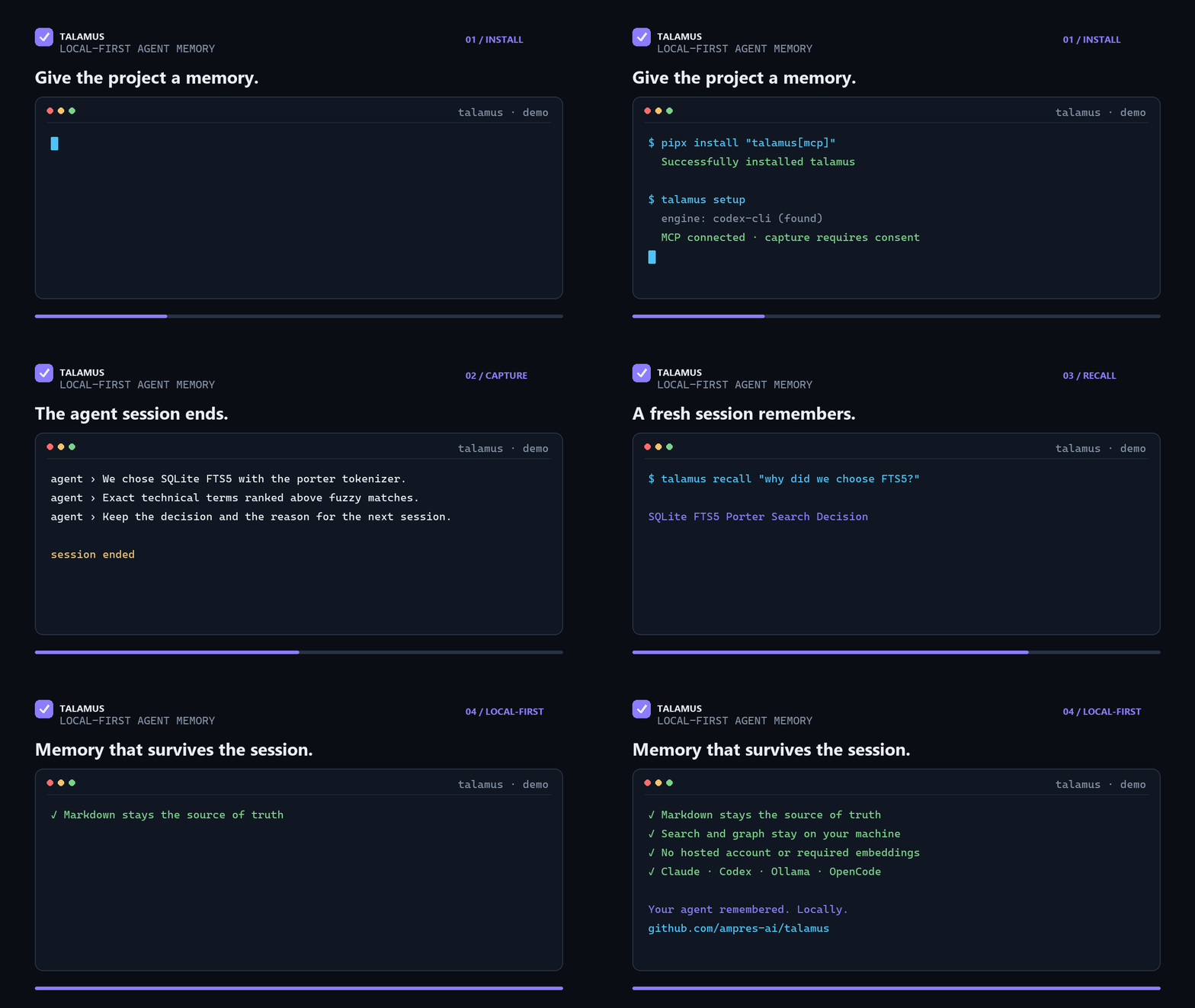 Talamus is an open-source project by [Ampres](https://ampres.io), an independent AI and open-source lab. ## Connect an agent Copy-pasteable arc, with the reproducible version in [`scripts/demo/run_magic.py`](https://github.com/ampres-ai/talamus/blob/main/scripts/demo/run_magic.py): 1. Set up the project brain. `talamus setup` initializes the brain, chooses an engine, installs MCP for Claude Code, Cursor, Codex, OpenCode, and OpenClaw when detected, asks once before installing the session-capture hook, and can probe the engine with one tiny live call. ```bash talamus setup ``` 2. Your agent session ends. The consented hook reads the transcript and git diff, applies the worth-remembering gate, writes only useful memory into this brain, and audits the event at `.talamus/logs/capture.log`. 3. A fresh session asks what happened and gets an answer from real notes, with sources. ```bash talamus recall "why did we choose FTS5?" talamus ask "why did we choose FTS5?" ``` 4. Reproduce the scripted demo without spending LLM calls, or run it with your real engine. ```bash python scripts/demo/run_magic.py --fake python scripts/demo/run_magic.py --keep --engine claude-cli ``` ## What is different **TIME**: notes have version history, facts have valid-time windows, and `talamus ask --as-of 2026-01` answers from the brain as it was. **MEANING**: the ontology is induced from evidence, versioned, promoted by measured rules, and used to cluster and route the brain. **VERIFIABILITY**: every note carries provenance; `talamus verify` proposes corrections to review, and answers cite the notes they used. ## Measured comparison The one-screen benchmark is rendered in the [benchmark guide](https://ampres-ai.github.io/talamus/benchmarks/) and committed as [`one-screen.md`](https://github.com/ampres-ai/talamus/blob/main/benchmarks/results/one-screen.md). Every number below traces to a [committed result artifact](https://github.com/ampres-ai/talamus/tree/main/benchmarks/results). | corpus | metric | Talamus | BM25 | MiniLM vector DB | |---|---:|---:|---:|---:| | SciFact, English-only turf | recall@10 | **0.797** | 0.776 | 0.783 | | SciFact, English-only turf | nDCG | **0.664** | 0.652 | 0.645 | | Book, cross-language + vague | hit@10 | **0.971** | 0.829 | 0.743 | | Book, cross-language + vague | recall@10 | **0.929** | 0.771 | 0.700 | Also measured in committed artifacts: **−97.7% tokens** per answer versus loading the brain into context, refusal **1.000** on out-of-scope questions, and search latency p95 **72.6 ms** at 10k notes / p50 **624 ms** at 100k. The honest part: retrieval quality tracks the LLM you bring. With a strong expansion engine, `talamus-smart` leads a strong multilingual dense model (`multilingual-e5`) on every metric including ranking (nDCG 0.847 vs 0.837); with a weak or free one, e5 leads ranking while Talamus keeps the best hit/recall — and on a slow local engine, plain `search` beats `--smart` outright. Every number traces to a committed artifact; the losses stay on the table. ## Engines Bring the LLM you already have: `claude-cli`, `codex-cli`, `antigravity-cli` (agy), `opencode`, `ollama`, or `anthropic-api`. ## Quickstart ```bash pipx install "talamus[mcp]" talamus setup talamus ingest ./notes && talamus ask "what should I remember?" ``` Run `talamus` for the status dashboard, `talamus quickstart` for essential commands, or `talamus ui` for the local React workbench. Install the consent-aware Talamus agent skill from [skills.sh](https://skills.sh): ```bash npx skills add ampres-ai/talamus --skill talamus-memory ``` OpenClaw can install the same standalone skill directly from ClawHub: ```bash openclaw skills install @ampres-ai/talamus-memory ``` Installing the standalone skill does not install Talamus automatically. If the CLI is missing, the skill explains the isolated installation choices and asks before running one. Gemini CLI can install Talamus directly from its extension gallery or from this repository. The extension starts the pinned PyPI release through `uvx`, so it does not modify the cloned source tree: ```bash gemini extensions install https://github.com/ampres-ai/talamus --auto-update ``` goose can install the repository as an Open Plugin. This adds the consent-aware memory skill and starts the pinned local MCP server for each new CLI session: ```bash goose plugin install https://github.com/ampres-ai/talamus.git ``` The plugin requires `uv` on `PATH`; `uvx` downloads Talamus and its MCP dependencies into an isolated cache on first use. Containerized MCP (the brain remains in the mounted local folder): ```bash docker run --rm -i -v "$PWD:/data" ghcr.io/ampres-ai/talamus:1.1.1 ``` ## Links Docs: [quickstart](https://ampres-ai.github.io/talamus/quickstart/), [local-first agent memory](https://ampres-ai.github.io/talamus/local-first-agent-memory/), [agent install guide](https://github.com/ampres-ai/talamus/blob/main/llms-install.md), [commands](https://ampres-ai.github.io/talamus/commands/), [agent tool calling](https://ampres-ai.github.io/talamus/agent-tool-calling/), [configuration](https://ampres-ai.github.io/talamus/configuration/), [benchmarks](https://ampres-ai.github.io/talamus/benchmarks/), [architecture](https://ampres-ai.github.io/talamus/architecture/), [design principles](https://ampres-ai.github.io/talamus/design-principles/), [evaluation](https://ampres-ai.github.io/talamus/evaluation/), [multi-brain](https://ampres-ai.github.io/talamus/multi-brain/), [ontology](https://ampres-ai.github.io/talamus/ontology/). Project: [security](https://github.com/ampres-ai/talamus/blob/main/SECURITY.md), [contributing](https://github.com/ampres-ai/talamus/blob/main/CONTRIBUTING.md), [roadmap](https://github.com/ampres-ai/talamus/blob/main/ROADMAP.md), [changelog](https://github.com/ampres-ai/talamus/blob/main/CHANGELOG.md). Maintained by [Ampres](https://ampres.io). Source code and issue tracking live at [ampres-ai/talamus](https://github.com/ampres-ai/talamus). ## Development ```bash pip install -e ".[dev,mcp]" python dev.py ``` `python dev.py` runs ruff, format check, mypy, and unittest. Product behavior changes should update user docs in the same change. ## License Apache-2.0.
What people ask about talamus
What is ampres-ai/talamus?
+
ampres-ai/talamus is mcp servers for the Claude AI ecosystem. Persistent, local-first memory for Claude Code, Codex, Cursor, Gemini CLI, OpenClaw and any MCP agent — cited Markdown, bitemporal history, no hosted account. It has 3 GitHub stars and was last updated today.
How do I install talamus?
+
You can install talamus by cloning the repository (https://github.com/ampres-ai/talamus) or following the README instructions on GitHub. ClaudeWave also provides quick install blocks on this page.
Is ampres-ai/talamus safe to use?
+
ampres-ai/talamus has not been audited yet by our security agent. Review the original repository on GitHub before using it in production.
Who maintains ampres-ai/talamus?
+
ampres-ai/talamus is maintained by ampres-ai. The last recorded GitHub activity is from today, with 4 open issues.
Are there alternatives to talamus?
+
Yes. On ClaudeWave you can browse similar mcp servers at /categories/mcp, sorted by popularity or recent activity.
Deploy talamus to your cloud
Ship this repo to production in minutes. Each platform spins up its own environment with editable env vars.
Maintain this repo? Add a badge to your README
Drop the badge into your GitHub README to show it's tracked on ClaudeWave. Each badge links back to this page and reflects the live Trust Score.
[](https://claudewave.com/repo/ampres-ai-talamus)<a href="https://claudewave.com/repo/ampres-ai-talamus"><img src="https://claudewave.com/api/badge/ampres-ai-talamus" alt="Featured on ClaudeWave: ampres-ai/talamus" width="320" height="64" /></a>More MCP Servers

Fair-code workflow automation platform with native AI capabilities. Combine visual building with custom code, self-host or cloud, 400+ integrations.

User-friendly AI Interface (Supports Ollama, OpenAI API, ...)

An open-source AI agent that brings the power of Gemini directly into your terminal.

The fastest path to AI-powered full stack observability, even for lean teams.

🕷️ An adaptive Web Scraping framework that handles everything from a single request to a full-scale crawl!

Real-time global intelligence dashboard. AI-powered news aggregation, geopolitical monitoring, and infrastructure tracking in a unified situational awareness interface