

Local project decisions, evidence and outcomes with bounded MCP retrieval and an offline HTML viewer.
- ✓Open-source license (MIT)
- ✓Actively maintained (<30d)
- ✓Clear description
- ✓Documented (README)
claude mcp add project-memory -- uvx project-memory-mcp{
"mcpServers": {
"project-memory": {
"command": "uvx",
"args": ["project-memory-mcp"]
}
}
}MCP Servers overview
# Project Memory Project Memory keeps a project's decisions, evidence, outcomes and reviewed lessons in a local SQLite database. An AI assistant retrieves the relevant records through three MCP tools; people inspect the same history in a self-contained HTML viewer. Use it when a project repeatedly revisits research, loses the reasons behind decisions, or carries outdated requirements into new work. It preserves the original evidence and the conditions under which a decision or lesson applies. **Public beta.** The runtime uses Python 3.11+ and its standard library. There is no model service, vector database, telemetry or background maintenance process. The assistant still interprets evidence and needs explicit agreement before accepting a lesson or changing project requirements. [Evidence and limits](docs/evidence.md) describe what has actually been measured. <!-- mcp-name: io.github.Dankaro-projects/project-memory --> ## Install and connect Install [uv](https://docs.astral.sh/uv/getting-started/installation/), then run this **inside the project you want to remember**: ```sh uvx project-memory-mcp@0.5.0b1 setup --client codex --trust ``` This creates `.memory/project.sqlite`, adds a project-local MCP connection and nine command hooks, and asks the installed Codex host for the exact hook hashes to enable. Existing settings and records are preserved. Open a new Codex task afterwards. `--trust` explicitly enables these project hooks; omit it to review and enable them in Codex yourself. For a permanent CLI installation: ```sh uv tool install project-memory-mcp==0.5.0b1 project-memory doctor project-memory view ``` For another local MCP client, run `project-memory setup --client mcp`, then configure the client to run `project-memory serve --project /absolute/path/to/project`. Generic MCP supports explicit records and retrieval; Codex's automatic receipts are a separately verified integration. [Setup and lifecycle](docs/setup.md) includes imports, upgrades, backup, uninstall and client configuration. The same versioned wheel is available from [GitHub Releases](https://github.com/Dankaro-projects/project-memory/releases). The MCPB asset supports directory selection in compatible desktop clients. 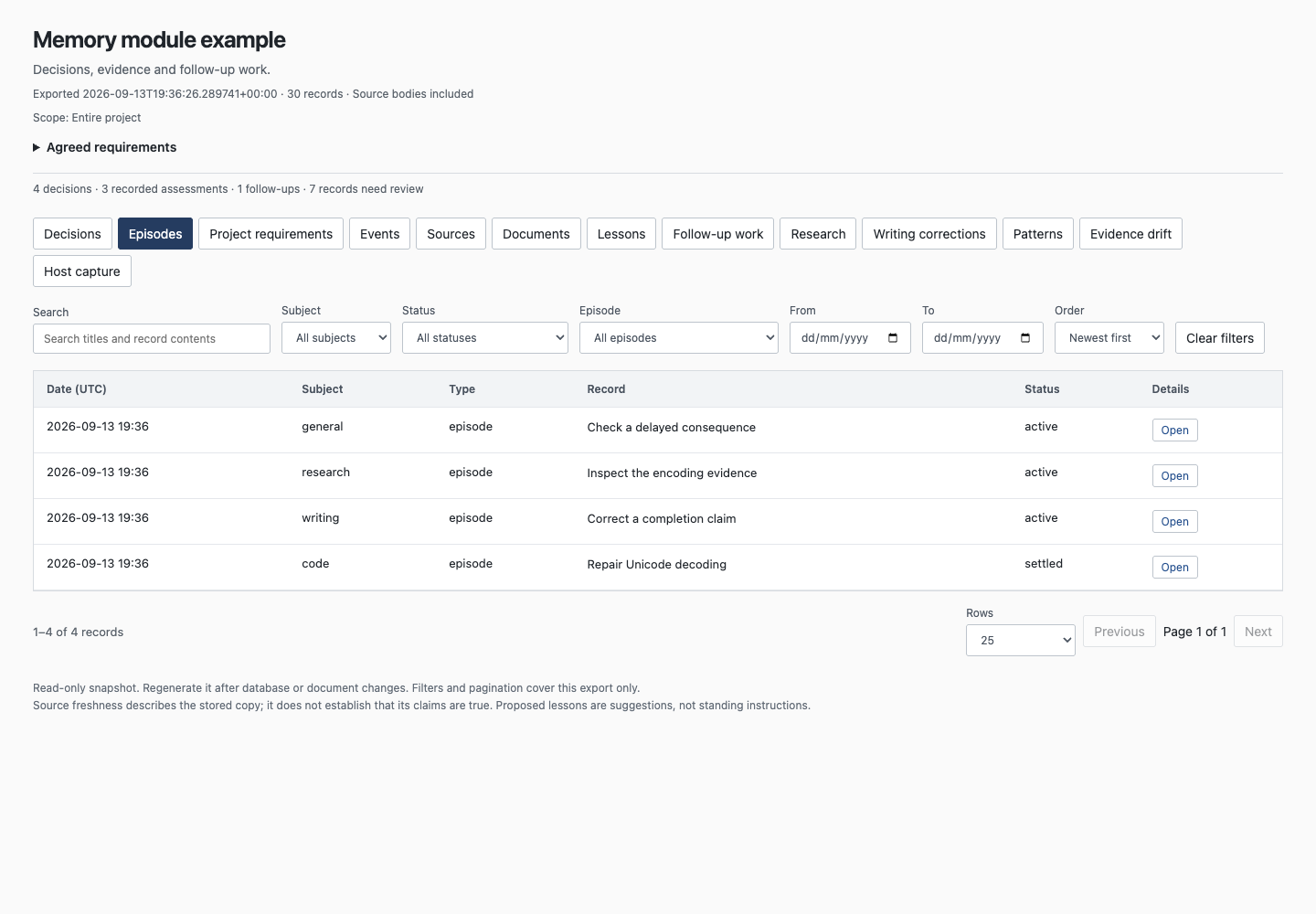 ## Use it in ordinary work Ask your assistant: > Capture VISION.md and our decision log. Show which statements are evidence, proposals and agreed requirements. Preserve the originals. Before choosing an approach, retrieve relevant decisions and check whether their evidence is still current. Then work normally. The assistant supplies record IDs and versions. You review the meaning, rather than maintain a second set of forms. - A decision records its evidence, initial choice, alternatives, uncertainty, expected consequences and conditions for reconsideration. - Actions and actual outcomes attach to that decision. Revisions retain the earlier choice and its result. - Successful practices, anti-patterns and recoveries can become proposed lessons. A separate review accepts, rejects or retires them, with their scope and exceptions intact. - Code reviews, writing corrections and research remain separate subjects. A dependency across subjects must name the evidence and explain why it matters. - Selected Markdown files are captured verbatim. Changed, missing and superseded evidence is flagged. Importing a vision does not approve its proposals. - Approved project requirements can evolve through append-only revisions. Earlier decisions retain the version they used and become reviewable when the agreed basis changes. Run `project-memory view` for decisions, documents, corrections, patterns, drift, captures and unresolved work. It creates a fresh, offline HTML snapshot with evidence navigation. Source bodies are excluded unless you add `--include-bodies`. ## What is automatic Codex hooks mechanically record session and tool events, sizes, hashes and available execution metadata. They do not turn a failed command into a lesson or assume that an interrupted command rolled back. The assistant records interpretation separately and checks side effects before retrying uncertain work. Retrieval returns bounded, complete records and preserves exceptions. Search indexes and explicit source slices support expansion when needed. The default MCP reply limit is 6,000 characters, with an explicit maximum of 20,000; these are **characters in the tool result, not complete model-input tokens**. Keeping every model input below 10K tokens remains a target, subordinate to quality and feature preservation. ## Develop and verify ```sh python -m unittest discover -s tests -q python -m examples.document_case --output results/documents python -m examples.host_example --output results/host-example node tests/viewer_logic.cjs uv build python scripts/check_artifacts.py dist python scripts/installed_smoke.py dist ``` The public artifacts contain code, documentation and synthetic examples. They exclude project databases, host transcripts, private evaluation archives and local configuration. [Contributing](CONTRIBUTING.md), [security](SECURITY.md), [record fields](docs/record-fields.md), [release process](docs/releasing.md).
What people ask about project-memory
What is Dankaro-projects/project-memory?
+
Dankaro-projects/project-memory is mcp servers for the Claude AI ecosystem. Local project decisions, evidence and outcomes with bounded MCP retrieval and an offline HTML viewer. It has 0 GitHub stars and its last recorded update is dated 2026-09-13.
How do I install project-memory?
+
You can install project-memory by cloning the repository (https://github.com/Dankaro-projects/project-memory) or following the README instructions on GitHub. ClaudeWave also provides quick install blocks on this page.
Is Dankaro-projects/project-memory safe to use?
+
Our security agent has analyzed Dankaro-projects/project-memory and assigned a Trust Score of 87/100 (tier: Trusted). See the full breakdown of passed checks and flags on this page.
Who maintains Dankaro-projects/project-memory?
+
Dankaro-projects/project-memory is maintained by Dankaro-projects. The last recorded GitHub activity is dated 2026-09-13, with 0 open issues.
Are there alternatives to project-memory?
+
Yes. On ClaudeWave you can browse similar mcp servers at /categories/mcp, sorted by popularity or recent activity.
Deploy project-memory to your cloud
Ship this repo to production in minutes. Each platform spins up its own environment with editable env vars.
Maintain this repo? Add a badge to your README
Drop the badge into your GitHub README to show it's tracked on ClaudeWave. Each badge links back to this page and reflects the live Trust Score.
[](https://claudewave.com/repo/dankaro-projects-project-memory)<a href="https://claudewave.com/repo/dankaro-projects-project-memory"><img src="https://claudewave.com/api/badge/dankaro-projects-project-memory" alt="Featured on ClaudeWave: Dankaro-projects/project-memory" width="320" height="64" /></a>More MCP Servers

Fair-code workflow automation platform with native AI capabilities. Combine visual building with custom code, self-host or cloud, 400+ integrations.

User-friendly AI Interface (Supports Ollama, OpenAI API, ...)

An open-source AI agent that brings the power of Gemini directly into your terminal.

Real-time global intelligence dashboard. AI-powered news aggregation, geopolitical monitoring, and infrastructure tracking in a unified situational awareness interface

🕷️ An adaptive Web Scraping framework that handles everything from a single request to a full-scale crawl!

The fastest path to AI-powered full stack observability, even for lean teams.