

- ✓Open-source license (MIT)
- ✓Actively maintained (<30d)
- ✓Documented (README)
- !No description
claude mcp add pywrit -- npx -y writ-scan{
"mcpServers": {
"pywrit": {
"command": "npx",
"args": ["-y", "writ-scan"],
"env": {
"WRIT_API_KEY": "<writ_api_key>"
}
}
}
}WRIT_API_KEYMCP Servers overview
# pywrit
**Find the dangerous writes in your Python agent's code, then gate it.** `pywrit` is the Python
client and `writ` CLI for [Writ](https://withwrit.com): an allow/deny gate that sits
in front of your agent's consequential writes (database, HTTP, files, email, queues,
AWS) and records a hash-chained receipt for every decision.
`writ scan` is **local, deterministic, and free**: it parses your code with Python's
`ast` module, makes no network calls, and needs no API key.
## Install
```bash
pip install pywrit
```
Requires Python 3.9+. Installs the `writ` command and the `pywrit` Python client.
**JavaScript/TypeScript devs:** run the scanner with no Python setup via npm:
```bash
npx writ-scan .
```
The `writ-scan` package wraps the same scanner (including TS/JS support). On
first run it installs `pywrit[polyglot]` from PyPI using your Python 3.9+
(one-time); afterwards it starts instantly. See [`npm/`](npm/) for details,
environment overrides (`WRIT_PYTHON`, `WRIT_SCAN_NO_INSTALL`), and the
install test.
## 60-second quickstart: scan → apply → gate
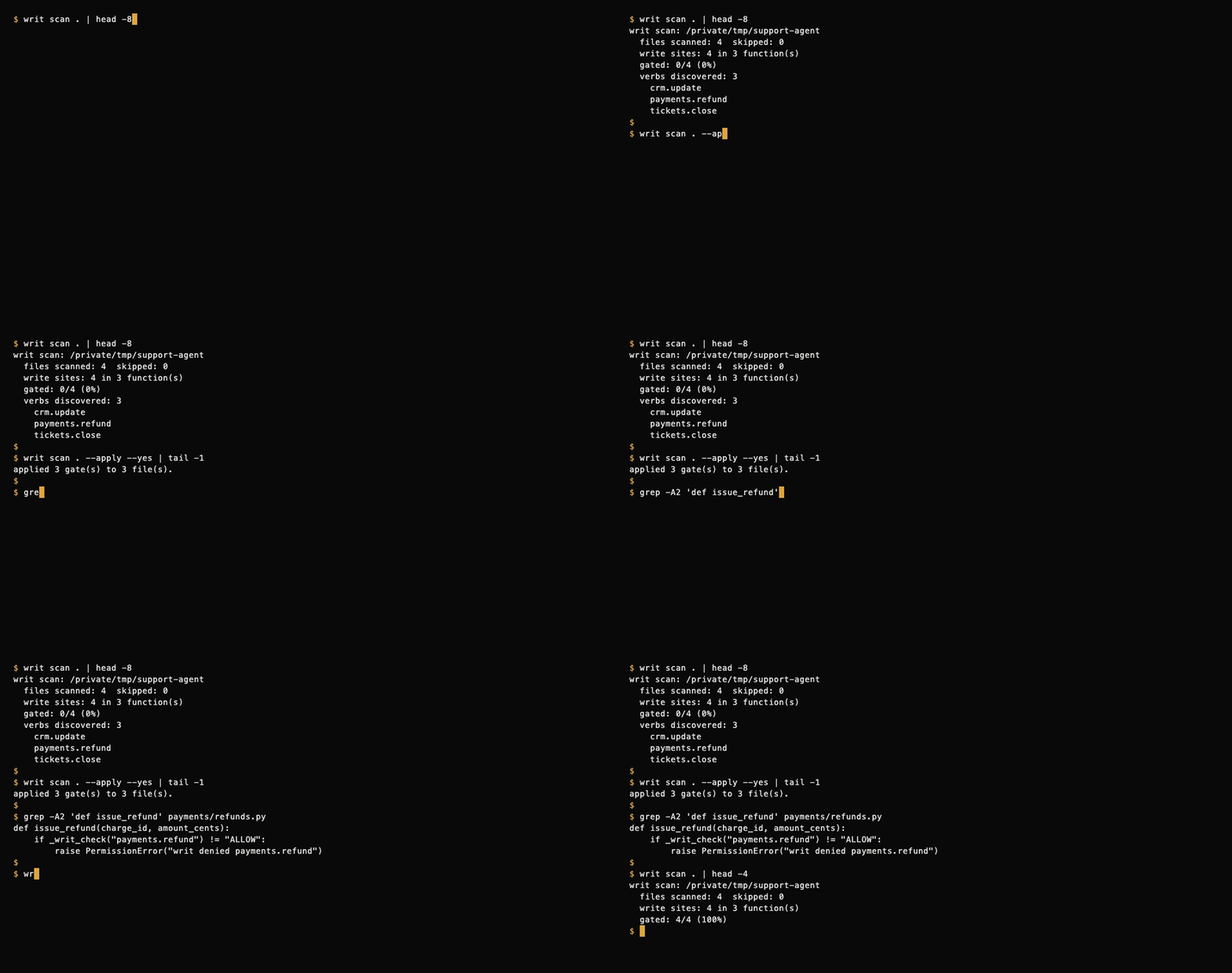
**1. Scan.** See which functions write, and how many of them are gated.
```bash
writ scan .
```
```text
writ scan: /path/to/support-agent
files scanned: 4 skipped: 0
write sites: 4 in 3 function(s)
gated: 0/4 (0%)
verbs discovered: 3
crm.update
payments.refund
tickets.close
```
It also prints a **risk report** (0-100, weighted by risk tier), writes the discovered
verbs to `writ-policy.json`, and shows the instrumentation it would add as a unified
diff. Nothing in your code changes yet. `writ scan . --score` prints just the risk report.
**2. Apply.** Insert a gate at the top of each writing function.
```bash
writ scan . --apply # shows the diff, then asks before writing
writ scan . --apply --yes # no prompt (e.g. in CI)
```
Each gated function now asks Writ before it writes, and fails closed:
```python
def issue_refund(charge_id, amount_cents):
if _writ_check("payments.refund") != "ALLOW":
raise PermissionError("writ denied payments.refund")
...
```
Re-run `writ scan .` and you'll see `gated: 4/4 (100%)`.
**3. Gate.** Get a free API key, load the discovered policy, and run your agent.
```bash
writ key --email you@example.com # free API key + tenant
export WRIT_API_KEY=writ_... # read by the inserted gate
export WRIT_SPONSOR=acme WRIT_AGENT=support-agent # optional: who is acting
writ scan . --push-policy --key "$WRIT_API_KEY" # upload the discovered verb policy
```
Every gated write now gets `ALLOW`, `DENY`, or `STEP_UP` (a human sponsor must
approve), and every decision is written to your tenant's tamper-evident audit log:
```bash
writ receipts --key "$WRIT_API_KEY" # latest receipts
writ verify-chain --key "$WRIT_API_KEY" # verify the receipt hash chain
writ stream --key "$WRIT_API_KEY" # tail decisions live
writ report --key "$WRIT_API_KEY" # Agent Action Report
```
## What `writ scan` detects
Python (`.py`) files, parsed with the stdlib `ast` (no extra dependencies):
| Category | Examples |
|---|---|
| Database | `cursor.execute(...)` / `executemany` / `executescript` (write SQL only; `SELECT`/`WITH`/... skipped), `session.add` / `commit` / `delete` / `merge` / `flush` |
| HTTP | `requests.post` / `put` / `patch`, `client.delete(...)`, `session.request(...)` |
| Files | `open(..., "w"/"a"/"x"/"+")`, `Path.write_text` / `write_bytes` / `unlink` / `rename`, `os.remove` / `rename` / `makedirs`, `shutil.rmtree` / `move` / `copy` |
| Email | `sendmail`, `send_message`, `send_email` |
| Queues | `publish`, `produce`, `enqueue`, `queue.send(...)` |
| AWS SDK | `put_object`, `put_item`, `delete_item`, `upload_file`, `send_message`, `start_execution`, ... |
- Each write is mapped to a verb such as `payments.refund` or `crm.update`, inferred
from the file path and function name.
- A function that already calls `writ_check(...)` / `_writ_check(...)` counts as gated.
- Skipped: tests, hidden directories, virtualenvs, `node_modules`, `dist`, `build`.
Use `--exclude SUBSTR` (repeatable) to skip more.
- Not covered (review by hand): writes behind dynamically built SQL, third-party SDK
calls such as `stripe.Refund.create(...)`, deferred task queues, or shared clients
several layers down. The risk report lists these gaps every time.
### TypeScript / JavaScript (scan-only)
`writ scan` also finds write sites in TypeScript and JavaScript. It needs the
optional extra (tree-sitter based):
pip install 'pywrit[polyglot]'
writ scan .
Without the extra, the scanner prints a one-line hint and keeps going —
Python scanning never needs it.
TS/JS is **scan-only**: findings are listed with verbs for your policy file,
but `writ scan --apply` never rewrites TS/JS files — gate those by hand.
Covered patterns: `fetch`/`axios` writes, `fs` writes, SQL through knex-style
clients, Prisma writes, and JS SDK calls such as `stripe.refunds.create(...)`.
(Still not covered: the *Python* SDK equivalents like `stripe.Refund.create(...)`
— see "Not covered" above.)

## GitHub Action
Scan every pull request for ungated write sites. Findings land as check
annotations on the exact file and line, plus a Markdown risk report in the
job summary. The check fails when an ungated finding meets your
`fail-on-risk` threshold (default: `high`).
```yaml
- uses: actions/checkout@v4
- uses: AvenueDAdmin/pywrit@v0
with:
fail-on-risk: high # high | medium | low | never
```
No API key needed. Full reference: [docs/github-action.md](docs/github-action.md) ·
example workflow: [examples/github-action/writ-scan.yml](examples/github-action/writ-scan.yml)
## Python client
```python
from pywrit import WritClient
client = WritClient(api_key="writ_...")
result = client.check(
sponsor_id="acme",
agent_id="agent-7",
verb="db.write",
target="prod.customers",
purpose="backfill region field",
)
if result.decision == "ALLOW":
# result.auth_token is a short-lived token bound to this exact write
perform_write(...)
elif result.decision == "STEP_UP":
# a human sponsor must approve first: client.grant(...), then re-check
...
else:
# DENY
...
```
No API key yet? Try the keyless sandbox:
```python
client = WritClient()
client.sandbox({
"sponsorId": "acme",
"agentId": "agent-7",
"verb": "demo_write", # sandbox only allows demo_write ...
"target": "demo-customers", # ... on targets starting with demo-
"purpose": "trying the gate",
})
```
What's covered:
- `check(...)`: the gate. `ALLOW` / `DENY` / `STEP_UP`, plus a receipt every time
- `verify_token(...)`: validate an `ALLOW` auth token (catches purpose drift)
- `grant(...)`: human-sponsor approval for the `STEP_UP` path
- `get_policy()` / `set_policy(...)`: manage the tenant policy
- `revoke(...)` / `reinstate(...)` / `revoked()`: the kill switch
- `receipts()` / `receipt(id)` / `verify_chain()` / `stream_receipts()`: the audit log
- `sandbox(...)`: keyless trial, no API key required
## CLI reference
```bash
writ check --key writ_... --sponsor acme --agent agent-7 \
--verb db.write --target prod.customers --purpose "backfill region field"
writ policy --key writ_... --set payments.refund require_grant
writ revoke --sponsor acme --agent agent-7 --reason "runaway loop" # kill switch (sponsor token)
writ grant --sponsor acme --agent agent-7 --verb payments.refund \
--target ch_123 --purpose "approved refund" # STEP_UP approval (sponsor token)
```
Sponsor-token commands (`revoke`, `reinstate`, `revoked`, `grant`) read
`--sponsor-token` or `WRIT_SPONSOR_TOKEN`. Run `writ --help` for the full command list.
## README badge
Show that your agent's writes are gated by Writ. Two flavors:
**Static** (works today, no API key) — same design, no live count:
```md
[](https://withwrit.com)
```
**Dynamic** (live 30-day gated-write count from your audit log) — mint a badge
token, then embed the snippet the API returns:
```bash
curl -s https://api.withwrit.com/v1/badge/tokens \
-H "Authorization: Bearer writ_..." \
-H "Content-Type: application/json" \
-d '{}'
```
The dynamic endpoint ships with the gate — until it's live, `POST /v1/badge/tokens`
returns 404 and the static badge above is the one to use.
See [`badge/`](badge/) for embed docs and the verification model (what the
badge proves — and what it doesn't).
## Docs
Full docs: [docs.withwrit.com](https://docs.withwrit.com) ·
Quickstart: [docs.withwrit.com/quickstart](https://docs.withwrit.com/quickstart) ·
Site: [withwrit.com](https://withwrit.com)
## License
MIT
What people ask about pywrit
What is AvenueDAdmin/pywrit?
+
AvenueDAdmin/pywrit is mcp servers for the Claude AI ecosystem with 1 GitHub stars.
How do I install pywrit?
+
You can install pywrit by cloning the repository (https://github.com/AvenueDAdmin/pywrit) or following the README instructions on GitHub. ClaudeWave also provides quick install blocks on this page.
Is AvenueDAdmin/pywrit safe to use?
+
Our security agent has analyzed AvenueDAdmin/pywrit and assigned a Trust Score of 80/100 (tier: Trusted). See the full breakdown of passed checks and flags on this page.
Who maintains AvenueDAdmin/pywrit?
+
AvenueDAdmin/pywrit is maintained by AvenueDAdmin. The last recorded GitHub activity is dated 2026-10-01, with 2 open issues.
Are there alternatives to pywrit?
+
Yes. On ClaudeWave you can browse similar mcp servers at /categories/mcp, sorted by popularity or recent activity.
Deploy pywrit to your cloud
Ship this repo to production in minutes. Each platform spins up its own environment with editable env vars.
Maintain this repo? Add a badge to your README
Drop the badge into your GitHub README to show it's tracked on ClaudeWave. Each badge links back to this page and reflects the live Trust Score.
[](https://claudewave.com/repo/avenuedadmin-pywrit)<a href="https://claudewave.com/repo/avenuedadmin-pywrit"><img src="https://claudewave.com/api/badge/avenuedadmin-pywrit" alt="Featured on ClaudeWave: AvenueDAdmin/pywrit" width="320" height="64" /></a>More MCP Servers

Fair-code workflow automation platform with native AI capabilities. Combine visual building with custom code, self-host or cloud, 400+ integrations.

User-friendly AI Interface (Supports Ollama, OpenAI API, ...)

An open-source AI agent that brings the power of Gemini directly into your terminal.

Real-time global intelligence dashboard. AI-powered news aggregation, geopolitical monitoring, and infrastructure tracking in a unified situational awareness interface

🕷️ An adaptive Web Scraping framework that handles everything from a single request to a full-scale crawl! Don't be shy, join here: https://discord.gg/EMgGbDceNQ and follow here for daily tips and tricks: https://x.com/Scrapling_dev

The fastest path to AI-powered full stack observability, even for lean teams.